
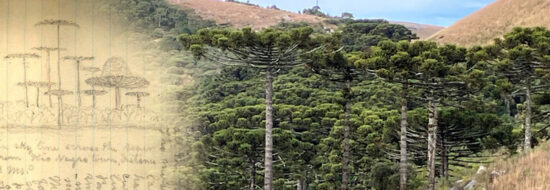
On August 12th, 1911, John Muir left New York on a ship bound for Belém, Brazil. He had just spent a couple of hot summer months on the East Coast, lobbying against the Hetch Hetchy Dam in Washington, DC, negotiating with his publishers in New York, and visiting old friends and colleagues. He was 73 years old, and was about to launch out on another of his improbable adventures. Why was Muir going to South America?
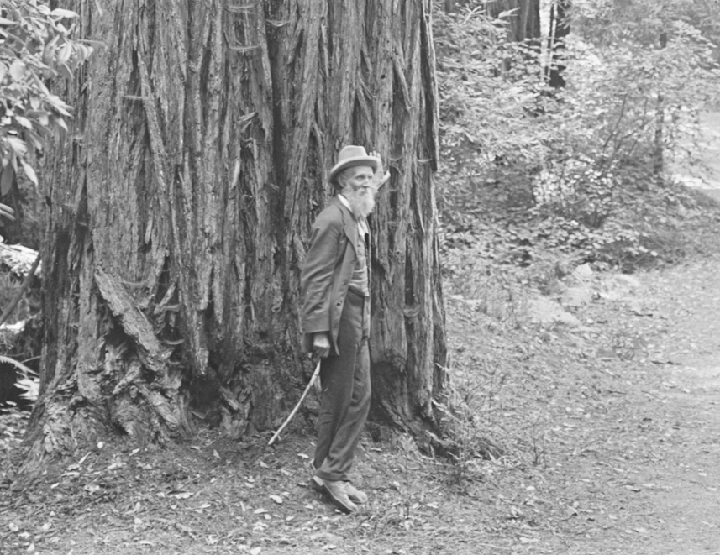
A proximate reason was, I think, that Muir loved big, old trees, and he was on a quest to see two species that met those criteria: Araucaria angustifolia (called the “Paraná Pine, although not a true pine) in Brazil, and Araucaria araucana in Chile. He had a special fascination, it seems, for members of the ancient conifer family Araucariaceae,1 whose evolution reaches back about 250 million years, to the Triassic Period. They have been called “living fossils,” more ancient, in evolutionary terms, than the more recent and more diverse families of angiosperm (flowering) trees more familiar to most of us, like oaks, maples, and willows. Some Araucarias are giant trees. Agathis australis, the kauri of New Zealand, is said to be the second or third largest tree species on Earth in terms of wood volume, a close rival for two of Muir’s home favorites, the giant sequoia, Sequoiadendron giganteum, found in the Sierra Nevada range, and Sequoia sempervirens, the coast redwood, from the California coast. Muir was an excellent botanist and knew that the living species of the Araucariaceae are found only on southern continents; he deliberately planned trips to see them in South America, Australia, and New Zealand.2
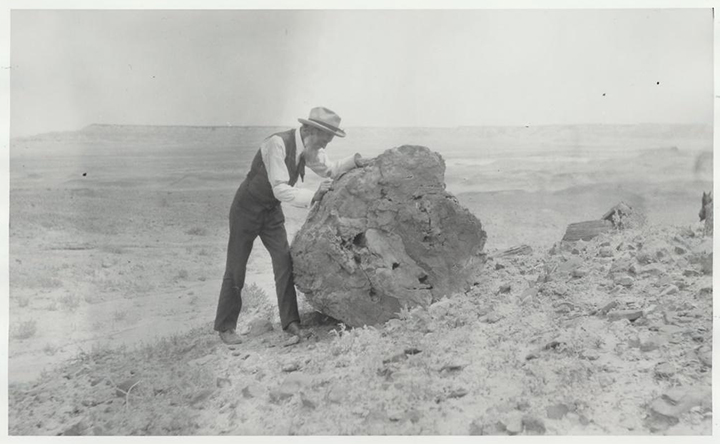
He also knew that the Araucariaceae were members of an ancient family from the time he spent in the Petrified Forest of Arizona in 1905. Muir’s personal library included a copy of the book Fossil Botany, published in 1891, in which he had made annotations regarding fossil Araucaria.
Another, deeper explanation for why Muir went to Brazil in 1911 surely arcs back to an earlier aspiration in his life. Like many scientists of the 19th century, Muir was an acolyte of Alexander von Humboldt, the great German polymath, explorer, scientist, and geographer. Humboldt’s scientific travelogue Personal Narrative of Travels to the Equinoctial Regions of the New Continent, during the Years 1799-1804, published in English in 1814, inspired Charles Darwin to join the Beagle voyage that established his views on evolution.5 Humboldt’s Narrative also inspired John Muir, and in the fall of 1867 he left Indianapolis, Indiana, where he had been working in a wagon wheel factory, and walked to Florida, an adventure described in A Thousand-Mile Walk to the Gulf, only published in 1916 after his death. His plan was to catch a ship for South America from there, where he imagined following Humboldt’s footsteps into the wild jungles of the Amazon.6 But he contracted malaria along the way, and after some months of recuperation, decided to go to California, where the climate was said to be healthy, to regain his strength. Soon after his arrival in San Francisco in 1868 he headed eastward to the Sierra Nevada Range, again on foot, and the rest is history, as they say: Muir became a scientist, influential nature writer, friend of politicians, founder of the Sierra Club, and “father of the national parks.”
Apparently, however, the Humboldtian travel bug had never gone away. In the first months of 1911 he was staying in Los Angeles, and on March 31st wrote to his daughter Helen: “You know I never like to travel, and somehow I feel less and less inclined to leave home than ever. Still, I must do the best I can.”7 Despite this hint of cognitive dissonance, Muir left for the East Coast on the Union Pacific a few weeks later. He would be gone for nearly a year. From New York, he went to South America, finally following his hero Humboldt—something he had abandoned for health reasons in 1868.8
Muir had turned 73 on April 21. His dear Scots friend, California landscape painter William Keith, had died on the eve of his departure. He must have been realizing that he did not have too many good travelling years ahead, especially for the long journey to South America and Africa he was contemplating. His wife, Louie, had died almost six years earlier, so he was no longer bound to his home in Martinez, California, and his daughters were well-situated. He had money enough to travel in comfortable style, not to mention the interesting personal connections his fame could generate in countries where he wanted to travel.
I also suspect that his urge to travel at that time stemmed from a growing frustration with the state of country and his conservation efforts in 1911. William Howard Taft had followed his friend Teddy Roosevelt as president in 1909, but Taft was not Teddy. And, related to that political shift, the campaign to dam the Hetch Hetchy Valley in Yosemite National Park was heating up; Muir may have had a premonition that the mood of the times and politics were turning against his vision of the spiritual value of nature and wild places. And, shucks, he may just have been feeling the same sense of adventure and curiosity that drove him to climb a tree in a windstorm to see how it would feel—his exuberant drive to see and feel the world for himself. A long solo trip to see big trees in wild forests of South America might provide a refreshing escape from the pressure of politics and his fame. Somehow related to that, I think, was Muir’s underlying feeling of the pull of “deep time” that the Araucariaceae represented, of finding meaning in the present through contact with an older, wider world.
His determination to see the “Paraná pine” was part of a quest – a quest from which we all can learn and be inspired.
_______
On May 28th, 2026, I boarded an overnight flight from Washington, DC, to Brazil, and arrived in Curitiba, capital of the state of Paraná, the following afternoon. My plan was to follow Muir’s route to the area where he had spent about two weeks observing and describing Araucaria angustifolia. Why was I following Muir, 115 years later?
For me, John Muir has always been an inspiration. He was a scientist, explorer, influential writer, nature philosopher, and a conservation hero. He influenced politicians, founded the Sierra Club, and is often called the “father of our national parks” because of his work to secure protection for Yosemite and other national parks and monuments. He was also an outdoor adventurer and nature lover. He may be for me what Humboldt was for him.
That provides some of the context for why I’ve long been curious about Muir and wanted to understand him better—to learn more from him, and somehow, maybe, intuit his advice about what we could and should be doing now, a century and more later. But I also wanted to be in the places where Muir was, see them with my own eyes, and somehow imagine, feel, and channel the curiosity, wonder, and delight that he expressed even in his sparsely worded journal. To walk in his footsteps.
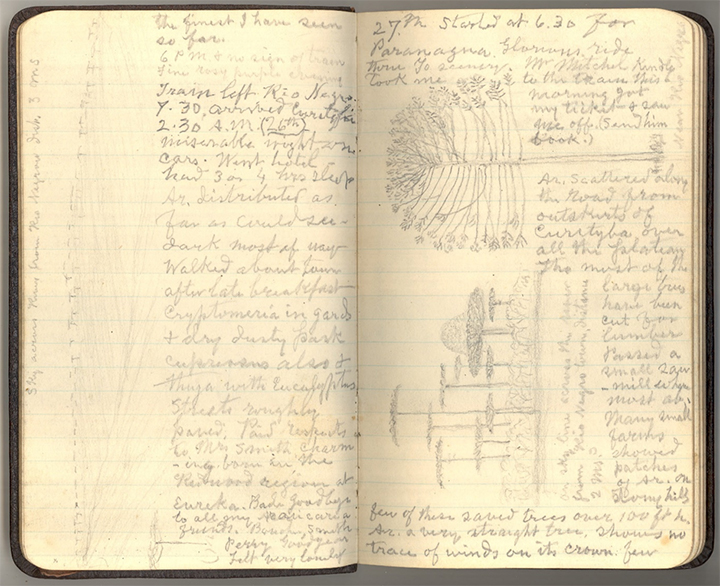
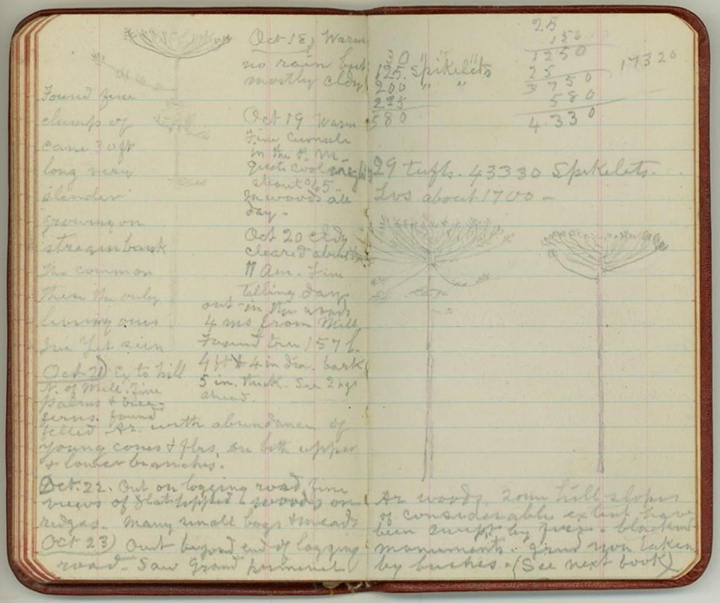
Muir was a disciplined journal-keeper, motivated I suspect by another hero of his, Henry David Thoreau, a consummate journalist. His journey to South America and Africa are recorded in three notebooks, from August 1911 to March 1912. They are part of the collection of the John Muir Papers at the University of the Pacific in Stockton, California, and are accessible in visual images and transcriptions online—an amazing research resource!9 Muir favored small, bound pocket notebooks, with pages only about three-and-a-half by five-and-a-half inches, I’d guess; I’ve held some of them in my gloved hands on a visit to the Muir archives. We can use his sketches—quite amazingly detailed and accurate, although small in size—and his notes and descriptions, in generally quite readable cursive—to travel along with him vicariously more than a century later, and imagine seeing through his eyes.
©1984 Muir-Hanna Trust
I had done that before this trip to Brazil. In 2012 my son Jonathan and I used the sketches and sparse notes in his 1911 travel journal to reconstruct and follow his route to the Andes of central Chile, where he found Araucaria araucana—sometimes called the “monkey puzzle tree.” After considerable sleuthing, we finally found the spot where Muir camped under those trees and sketched the Araucaria forest around him. We eventually made two more trips with Chilean ecologists and conservationists to document forest change at the site and strategize about how to conserve it. I wrote a number of essays and articles about that episode of Muir-chasing.10 I’m now planning a new book project, following Muir on his global Araucaria quest not only to Chile and Brazil, but on to Australia and New Zealand, where he had also seen them on an around-the-world trip in 1903-1904.
In his book John Muir in India,11 Harold Wood, a Muir expert, says: “In any case, Muir’s journals and letters home during this period [1903 in that case] contain only a hint of what he saw and felt in India and the other places he visited on his global travels. His journals served only as a reference for future writing— in this particular case, never fulfilled. Because they were scribbled as they were at odd moments, they lack detail.” The same could be said, in general, for Muir’s journals and letters from his 1911 trip to South America. Perhaps he intended to write about seeing Araucarias in Brazil and Chile someday, but he never did. So, in following Muir’s footsteps through his journals we have to have an open mind and use our own imagination.12
_______
We know from Muir’s correspondence with friends and family that he had been thinking for at least several months of going on to South America after his trip east. He had already told his Stanford University friends, the Kelloggs, about his plan to be in South America in the fall; in a January letter, Charlotte Kellogg wrote: “And what of this great adventure? Chili sounds alluring—do send us a card as often as you can.” In a response dated February 11th, Muir wrote: “I want to go to the Araucaria imbricata [referring to the Andean species] forests & across to Brazil. & to South Africa.”13 That letter suggests he intended to go to Chile first, then back to Brazil. After leaving New York on August 12th, he reached Belém, at the mouth of the Amazon, on August 28th. He went up the river to Manaus and was back in Belém by September 15th. In a letter to his daughter Helen from there Muir wrote that he was “waiting for a steamer to Rio,” and “From Rio I plan to go to Buenos Aires.” The original plan, to go from Brazil to Argentina and on to Chile by train, still seemed to be on track.
But two days later, on September 20th, still in Belém, he wrote to his friends the Osborns, “I am now waiting for a steamer to Rio. Will probably get away on the 25th of this month. From Rio after a short stay I plan to go [to] Buenos Aires, thence up the La Plata and Uruguay rivers.”14 Suddenly, the plan seems to have changed—to go to look for Araucaria angustifolia in Brazil first, by going north and east up the Uruguay River to its headwaters in the highlands of the Serra Geral mountains. The reason for that sudden change of plans isn’t completely clear. Muir seems to have had only a vague idea of the distribution of his target species, probably from his botanist friend Professor John C. Branner of Stanford, who had travelled to Brazil in 1889; Branner had apparently showed him a couple of photos of the species taken on the upper Uruguay River. It would have been a long trip from Buenos Aires up the Uruguay River to Paraná pine country—something like 800 or 1,000 miles!15
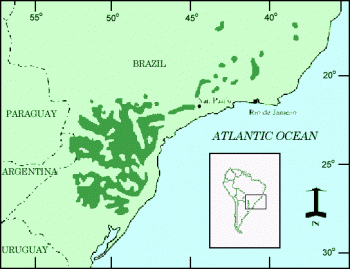
And then, again suddenly, another change of plans. On the ship from Belém to Rio de Janeiro, Muir met a Mr. Harell, an American apparently. They arrived in Rio on October 7th and spent a few days sightseeing there together before leaving on another southbound ship on October 10th. Only then do we get a clue, in a short letter to his daughter Helen, that Muir was changing his plan to find the “Paraná pine” by going inland from the port city of Santos on the coast south of Rio, rather than around and up the Uruguay River from Buenos Aires: “1911 Rio de Janeiro Oct 10 Darling Helen, Ive been here 3 days & leave today for Santos. Thence I go inland 4 or 5 hundred miles to look for Araucaria Braziliensis in the state of Parana. … I’ll return to Rio from the woods thence go to Buenos Aires. Thence to Valparaiso etc. I am feeling quite well & of course fondly hope you & family are.”17 In his journal entry for 10 October, after posting the letter to Helen, Muir wrote from shipboard: “Sailed for Santos at five o’clock this afternoon. Found Mr. Harell, who introduced me to Mr. Bouchet, Superintendent of Parana Lumber Company, owning nearly a million acres of araucaria forest, which I hope to see. I am cordially invited to travel with Mr. Bouchet’s party. This will save [me a] long trip up the Uruguay [River].”18
It certainly would, and did. It was a no-brainer for Muir to suddenly change plans, given the serendipity of the invitation to go to the Araucaria woods with the American loggers. And we shouldn’t be surprised. All his life Muir had been a spontaneous adventurer, open to following where fate took him—even when that adventurous spirit seemed many times to put him at great risk. His solo climb of Mount Ritter in the Sierra Nevada in 1872 is perhaps the most striking example; his journal hints at how he was finding the route up the glaciers and cliffs as he went—and easily could have died in the process.19
_______
Off on his new route to the Araucaria, Muir’s journal for October 12th describes his “interesting railway ride to São Paulo” from the coffee port of Santos, over the coastal mountain range onto the high interior plateau; he comments on the expensive and technically sophisticated tunnels and bridges, “well built by an English company.” He wrote that he “Was delighted to discover specimens of Araucaria braziliensis on the plateau 15 or 20 miles from São Paulo.” I take his use of the word “delighted” literally, and can imagine how he was feeling.
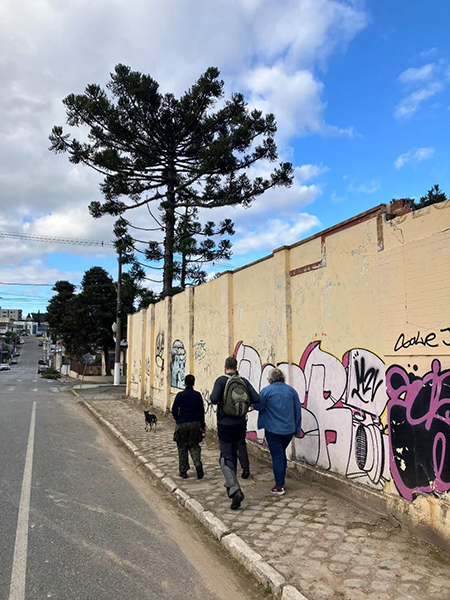
Like Muir, I was surprised and also delighted to discover Araucaria as soon as I arrived in Curitiba. I could see their iconic shapes not far from the runway as we landed at Afonso Pena International Airport, from my taxi to the hotel, from my room on the eighth floor, and along neighborhood streets on the walk from the hotel to the university the next morning.
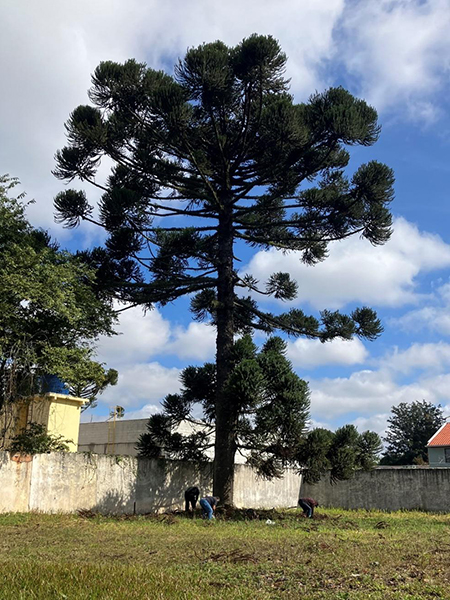
Muir stayed at a hotel near the train station in São Paulo, and left late the next afternoon for Porto Amazonas in a sleeping car, presumably with at least some of the American loggers he’d met on the ship from Rio. He described seeing a few Araucarias before dark, and then on the morning of October 14th wrote: “Araucarias in hundreds and thousands. Wondrous sight. Seems to bear fire better than other trees. At 11:00 A.M. still winding among hills of gentle prairie table-land. Fine grassy cattle country. Araucarias on the hills very telling, along white cloud horizon. Flat-topped. Old above arrow-head young. Same in hollows, all ages and shapes. Some double-headed. Flat or up-curved or dome-shaped.” He sketched the diversity of growth forms he described in his journal.
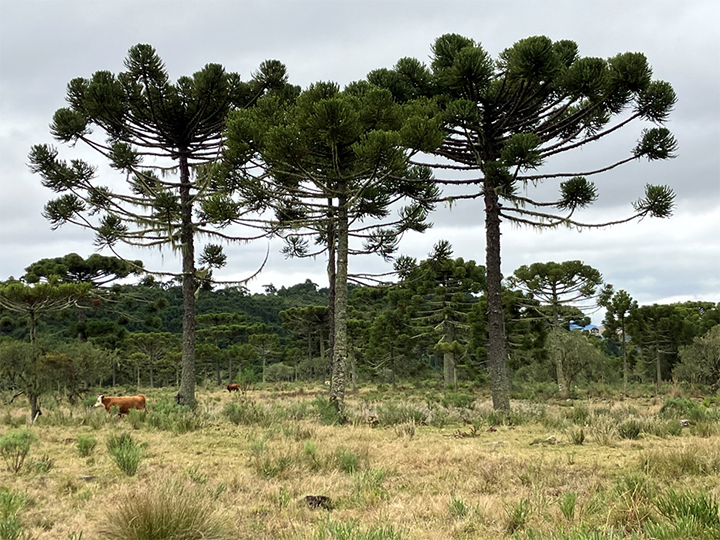
Still on the train on October 14th, he “Passed through extensive forest today about noon. Later the country was one wide prairie with Araucarias only here and there along the streams & on hilltops in detached groves. Wonderful effect made by the crowns of umbrella tops rising above each other. Fair and sunny in the afternoon, with magnificent white cumuli here and there, on which the araucarias were most strikingly relieved.”
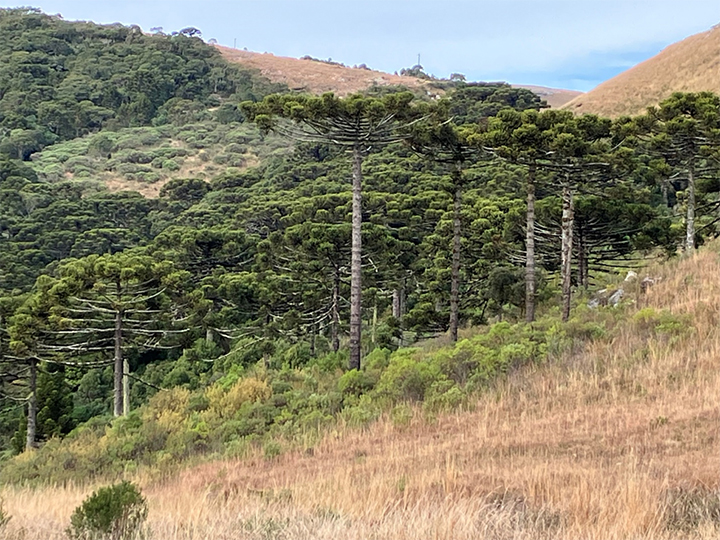
In the afternoon the train arrived “at Port Amazon on Iguassu River. Mr. Smith met us at the R.R. [railroad] junction with special train to carry us to the river [landing]. Warmly welcomed by Mr. Smith, who is Californian & knows many of my old friends. Staid [stayed] last eve at Port Amazon at Portugese [sic] home with a thrifty orange grove, vegetable & flower gardens, & fine Araucaria grove of 10 or 15 acres back of the house. The tallest of the trees are about 120 ft [feet tall] & 2-3 ft dia. [feet in diameter]. No lack of hopeful quick-growing seedlings & saplings for renewal of the forest after mature trees are removed.”20 With regard to “Mr. Smith,” Muir identifies him later in the journal as “Mr. Ira P. Smith, Manager, Southern Brazil R.R.?, Curitiba, State of Parana (Trez Barras).”21
After staying a night with the Portuguese family, Muir’s journal records: “October 16. Left Port Amazon last eve at 2:30. Sailed on the little river steamer Iguassu downstream on the river of same name until 8:00 A.M. then up a tributary less than hour to mill.” The tributary is the Rio Negro, flowing west from its headwaters in the coastal Serra Geral mountains.
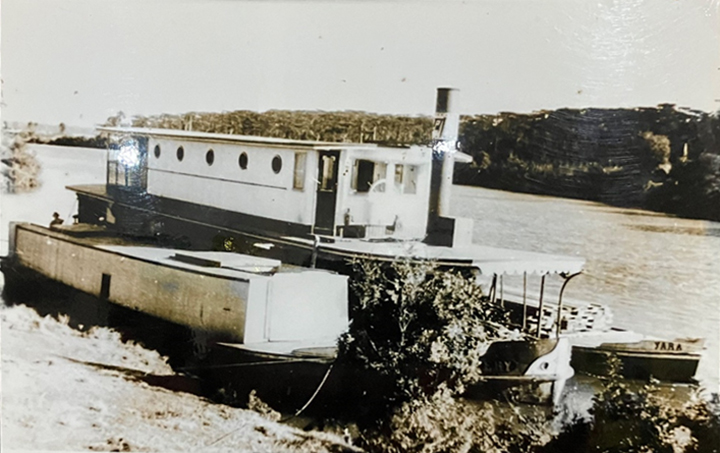
(Source: Municipal Museum, Tres Barras)
After reaching the mill at Tres Barras, Muir was finally able to get up close and personal with this long-sought species of Araucaria—thanks to the American lumbermen who were intent on cutting it down! Nowhere in his journal does Muir lament the logging. He notes only that the logging roads radiating out a few miles from the newly established mill allowed him to get into the forest and study the trees. He could even examine their crowns because they were lying on the ground, not 100 or more feet above him, as they would have been in an intact forest. He counted and measured their branches and studied their cones, happily burying himself, it seems, in scientific measurement and minutiae.
©1984 Muir-Hanna Trust
His journal from October 17: “Out all day in the woods. Nearly all the trees are Araucarias, forming almost pure forest. One specimen tree that I carefully measured was about two and a half feet in diameter four feet above the ground, one hundred and twenty-five feet high, and the crown was about fifty-five feet in diameter. The first limb was at a height of about eighty feet.”22
On October 20 he wrote: “October 20. Cloudy. Cleared about 11:00 A.M. Delightful day. Out in the woods four miles from the mill. Found a tree in hundred and fifty-seven feet high, four feet four inches in diameter; bark five inches thick.”
“Oct. 23. Out beyond end of logging road four or five miles from mill, in magnificent primeval Ar. woods. Some of the hill slopes of considerable extent have been swept by fire, killing every tree, leaving only blackened charred monuments. The ground now taken by a dense growth of bushes. … A tree felled a few days ago had limbs finely curved 30½ ft l [long], 5 inches dia. [diameter] at the base. … Diameter of the trunk two feet above the ground was three feet. Ninety-six feet above the ground the diameter was twenty-two inches. Bark on the stump two and one-half inches. In analysis of the leafy tufts forming the ends of the branches I counted thirty-eight branchlets. Second and third branchlets two hundred and ninety-two. Leaves in a tuft, 57,232. Number of leaves in a whole crown about 3,491,152.”23
Historical photos, many collected and displayed in the Municipal Museum in Tres Barras, help us imagine the scene at the logging camp when Muir visited.
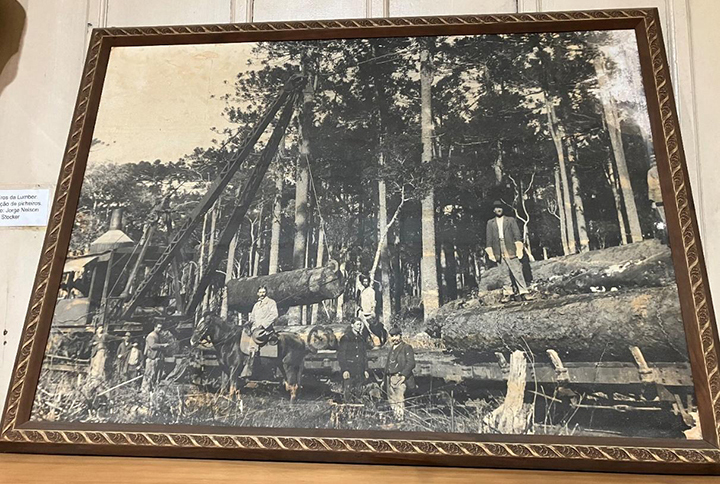
(Source: Municipal Museum, Tres Barras)
Muir mentions his observations about the fire tolerance of A. angustifolia several times in his journal. From the train from São Paulo to Porto Amazonas, he noted that he saw some trees that had been killed by fire, and in the next sentence mentioned their lower-branch-shedding growth form—an adaptation to fire in many species he would have been familiar with, such as ponderosa pine in California. He commented that Araucaria “Seems to bear fire better than other trees.” When he got his first up-close look at mature trees in Porto Amazonas, he wrote: “Bark on lower part of trunk very thick 2 or 3 inches. Explains resistance to fire.”
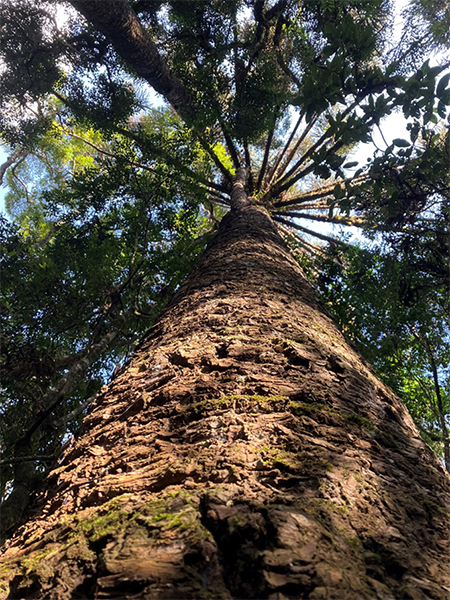
June 2026
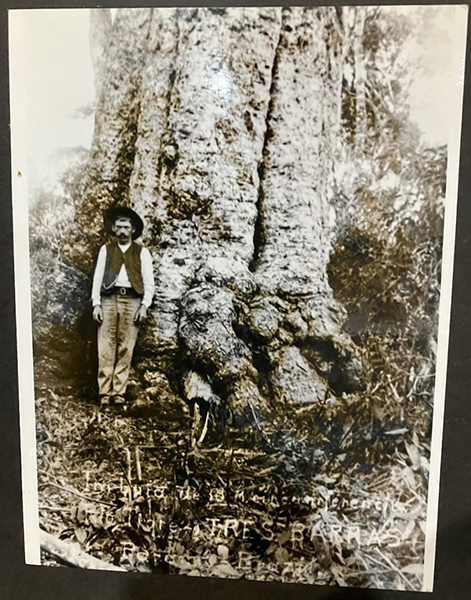
(Source: Municipal Museum, Tres Barras)
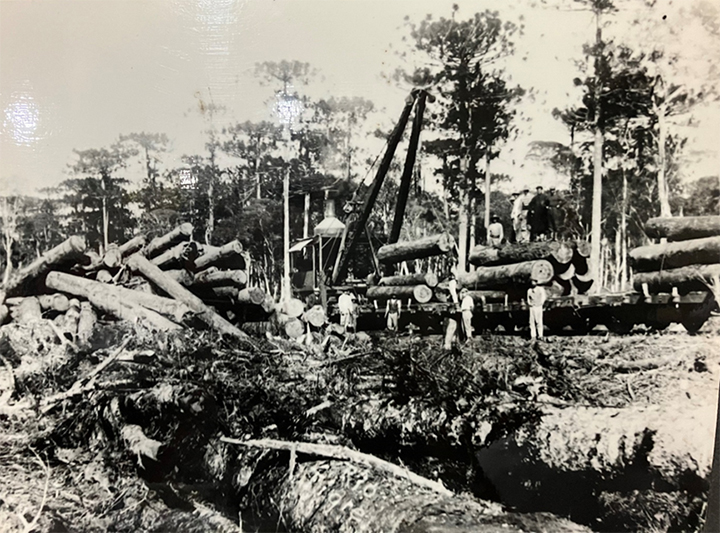
(Source: Municipal Museum, Tres Barras)
Muir finally left the lumber camp on Oct. 24th: “Cloudy. Magnificent cumuli about noon. Mill running. Leave this hospitable camp about six o’clock this evening. Most interesting forest I have seen in my whole life. Formal, yet variable, and always impressive with auld-lang-syne Sequoia-like physiognomy.”24
He spent from October 16th to 24th—nine days—with the loggers at Tres Barras, a relatively long time compared to other stages of his journey, when he seemed to be in a big hurry, rushing to travel, see, and move on very quickly. Reading his journal, I often feel exhausted at the pace of travel he set; many nights were on trains, and in stopover cities often only one night in a hotel before moving on.
Muir called the lumber mill at Tres Barras a “hospitable camp.” Why did he stay so long there? From his journal, we can’t be sure. Maybe he was constrained by the travel opportunities available—for example, the next river steamer to get back to outside “civilization” from the mill might not have been until October 24th. That’s my guess, given how fast he usually travelled, but maybe he was content to stay in comfortable accommodations, hob-nob with his American hosts, and wander the primeval Araucaria forests all day. He was obviously enchanted by the forest around Tres Barras, describing it as the “most interesting forest I have seen in my whole life.” At his age, Muir had seen a lot of forests—including 210-million-year-old fossil forests—but this one seems to have given him a feeling of nostalgia, an “auld-lang-syne” emotion, perhaps reflecting his knowledge that these were ancient trees in both a contemporary and an evolutionary sense.
_______
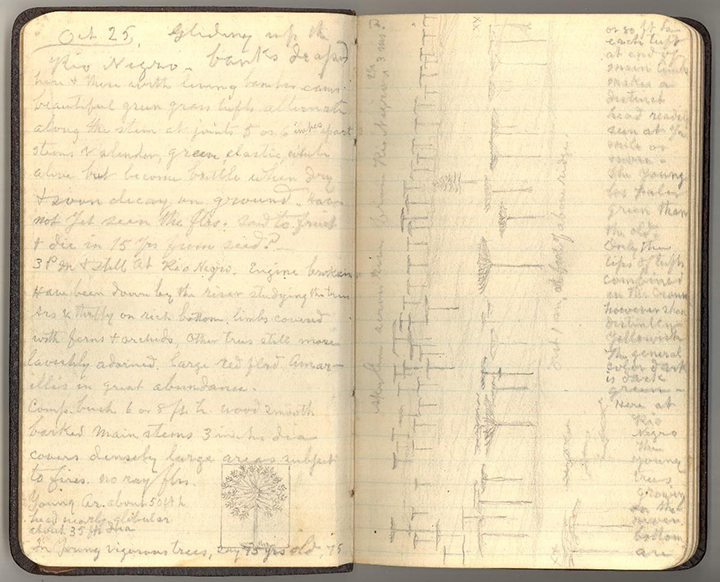
After leaving Tres Barras, Muir took another small river steamer overnight, eastward up the Rio Negro to the town of Rio Negro: “We arrived at the village or town of Rio Negro about 6:30 this A.M. Twelve hours sail up the river of same name. Fine stream; picturesque brushy banks. Ar. trees common, on low flooded ground as well as on hills. Magnificent views of Ar. crowned hills and slopes from high streets. Have been trying to sketch some of them. Here we take train for Currityba at 1:20 P.M. Expect to arrive about eight o’clock.”25
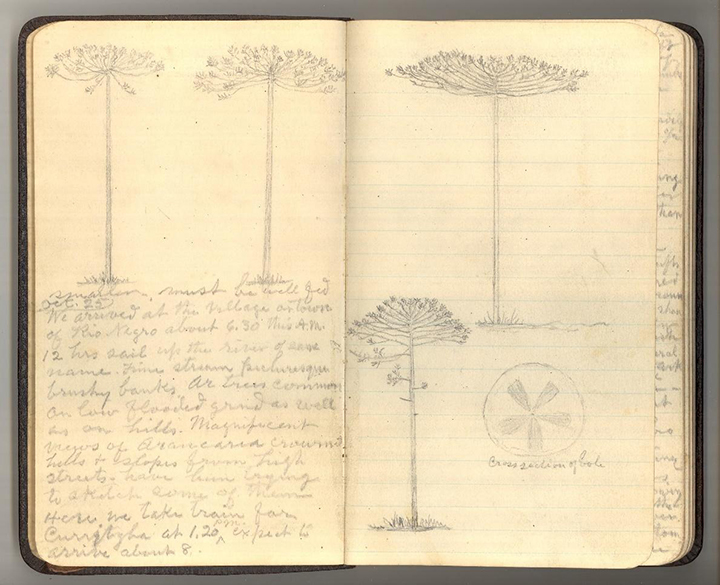
©1984 Muir-Hanna Trust
_______
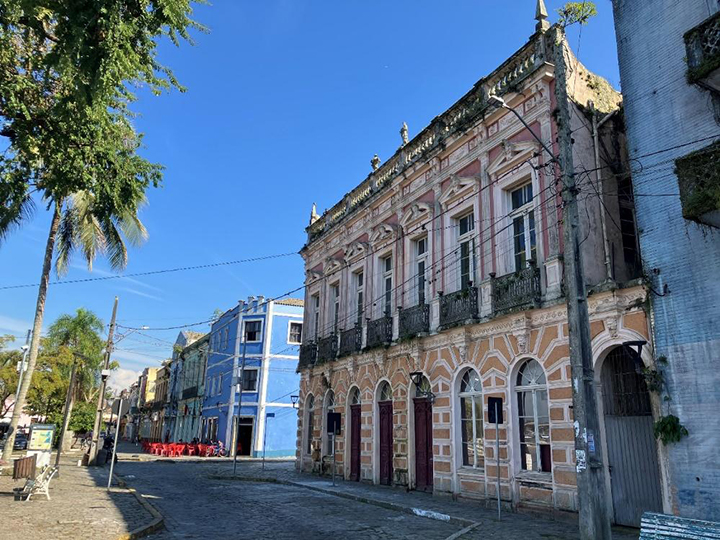
I arrived in Rio Negro after lunch on a sunny afternoon in early June, after a drive upriver from Tres Barras, with Professor Marcos Carlucci, an ecologist and Araucaria expert from the Federal University of Paraná in Curitiba, and his graduate students Gabrielle and Amanda. We parked next to the church and sauntered downhill through the old town square—the “praça” in Portuguese—not quite knowing how we would orient ourselves or find the places where Muir stood, saw, and sketched.
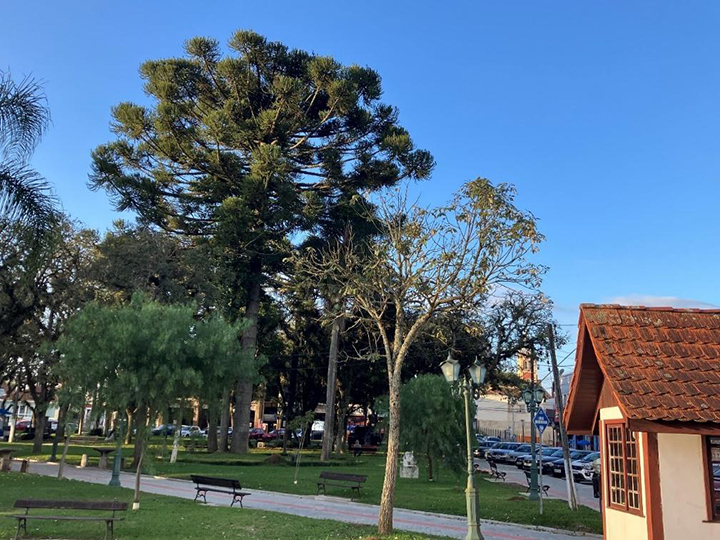
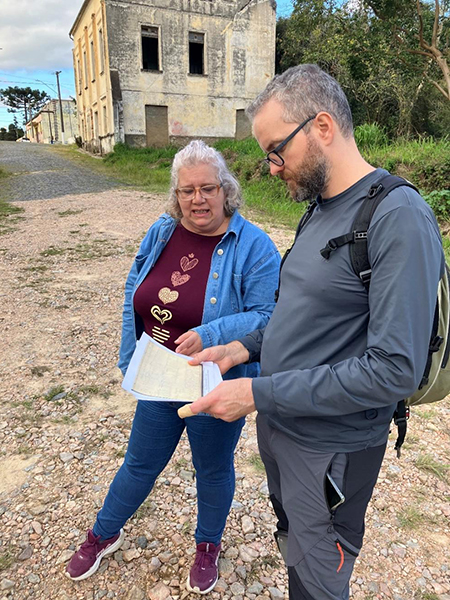
Across from the plaza was the town hall, a solid, older-looking building, and we thought someone there might be able to at least give us a map, or point us to a local history museum. We greeted someone sitting behind a desk and Marcos quickly explained our mission—which I assumed would sound totally weird—but before we knew it, out of another office came a short woman with short gray hair, who was introduced as a longtime local resident and history expert, Kelly Peters. She had heard of John Muir, although not of his visit to Rio Negro, and she seemed delighted that someone looking to follow his footsteps in her hometown had arrived unexpectedly on her doorstep. It was getting late in the afternoon, probably 3:30 or 4 P.M., and in winter in southern Brazil now it was dark about 5:30. We didn’t have too much time, but Kelly took off walking with us, looking at Muir’s sketches, and interpreting his descriptions of the town he visited 115 years ago.
Her local knowledge enabled her to fill in gaps in the “picture” that Muir did not describe in his journal. She immediately cleared up one thing that had been confusing us. Muir described going to “Rio Negro,” but today the city with that name is on the north side of the river, with the plaza and town hall, in the Brazilian state of Paraná; just across on the south side, in the state of Santa Catarina, is the city of Mafra. Muir mentions sketching “from the dock” or “from the high streets” of Rio Negro, but not whether he was on the north or south side of the river. Kelly explained that in 1911 the town called Rio Negro was on both sides of the river. It was several years later that the town was split in two, divided by the river that became the boundary of Paraná and Santa Catarina states, at the end of the Contestado War. That war, essentially a war for control of the Araucaria forest, is a fascinating story, which I’ll save for a later essay.
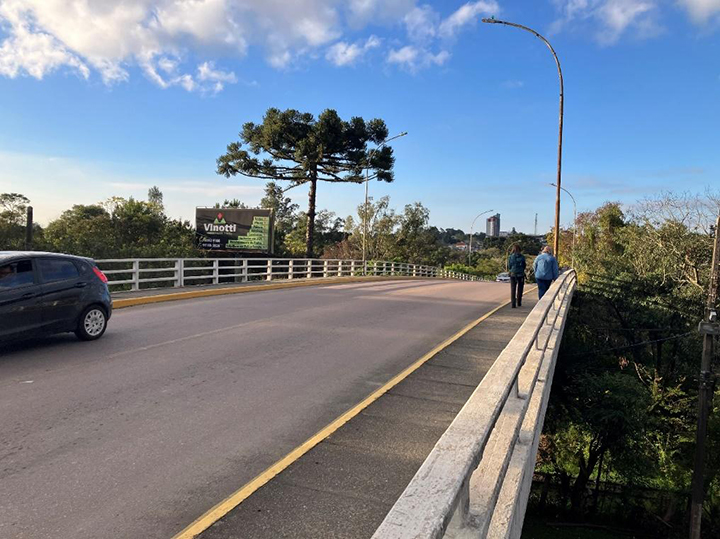
Today a rusting iron bridge crosses the river. Muir never mentioned this bridge, but it was there when he visited, Kelly told us. It was built in the late 1800s for horse, wagon, and pedestrian traffic; Muir must have walked across it. The dock where he arrived on the river steamer from Tres Barras was just downstream from this bridge on the south side of the river. A large warehouse for collection and shipment of yerba mate—erva-mate in Portuguese—stood on the north bank just upstream from the bridge. A little farther up was a railroad bridge where the train Muir eventually took to Curitiba crossed the river. The train station is now gone, replaced by an elementary school.
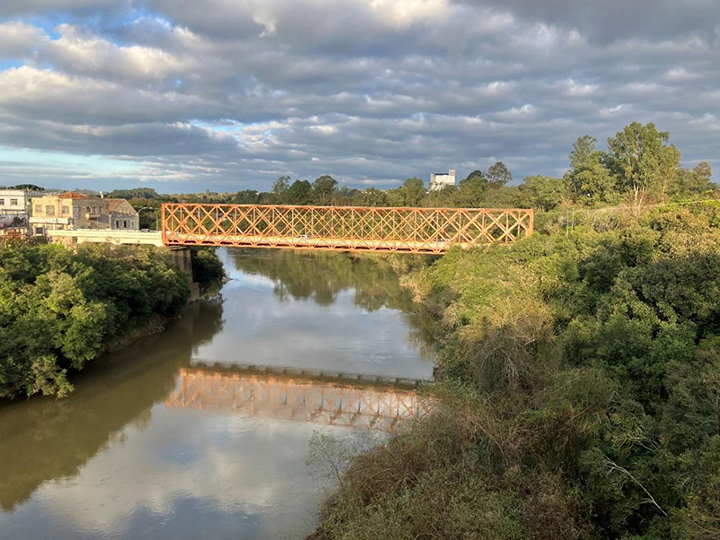
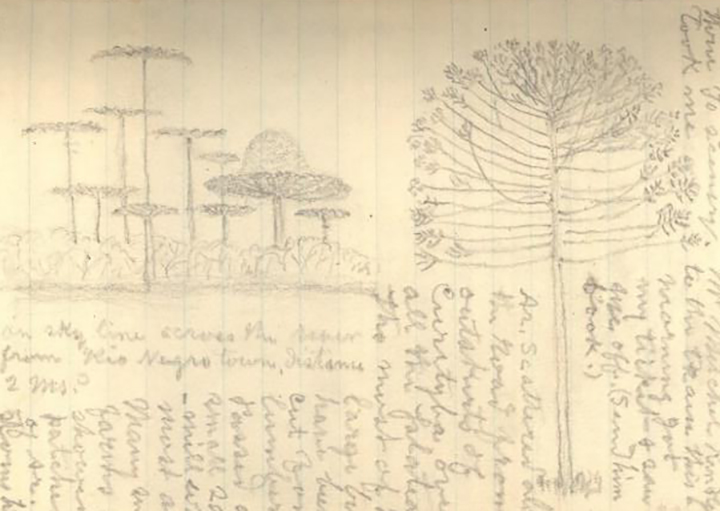
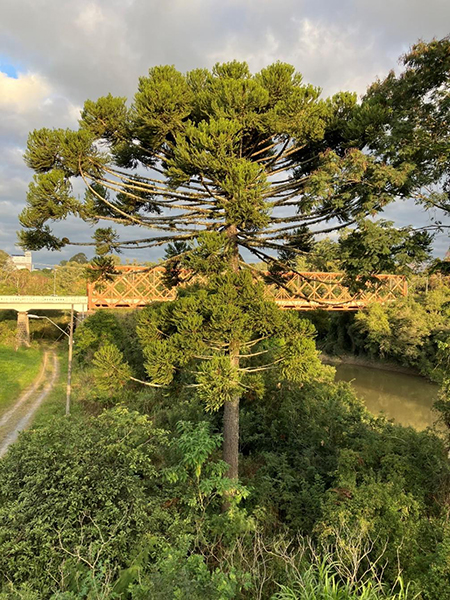
“Here at Rio Negro the young trees growing on the river bottom are the finest I have so far seen,” Muir wrote, and “A row of Ar. crowning the top of a ridge about three miles distant make a striking effect.”
University of the Pacific Library. ©1984 Muir-Hanna Trust
©1984 Muir-Hanna Trust
![“Skyline across River from Rio Negro 2-1/2 – 3 m[ile]s ?”
Detail of John Muir Journal "October-November 1911, Trip to South America, Part II” Image 4 https://scholarlycommons.pacific.edu/jmj-all/3325/, John Muir Papers, Holt-Atherton Special Collections and Archives, University of the Pacific Library. ©1984 Muir-Hanna Trust](http://www.brucebyersconsulting.com/wp-content/uploads/2026/07/Brazil-Muir23.jpg)
Detail of John Muir Journal “October-November 1911, Trip to South America, Part II” Image 4 https://scholarlycommons.pacific.edu/jmj-all/3325/, John Muir Papers, Holt-Atherton Special Collections and Archives,
University of the Pacific Library. ©1984 Muir-Hanna Trust
![“Sky[line] across River from Rio Negro dist. 3 m[ile]s”
Detail of John Muir Journal "October-November 1911, Trip to South America, Part II” Image 5, https://scholarlycommons.pacific.edu/jmj-all/3326/, John Muir Papers, Holt-Atherton Special Collections and Archives, University of the Pacific Library. ©1984 Muir-Hanna Trust](http://www.brucebyersconsulting.com/wp-content/uploads/2026/07/Brazil-Muir25.jpg)
Detail of John Muir Journal “October-November 1911, Trip to South America, Part II” Image 5, https://scholarlycommons.pacific.edu/jmj-all/3326/, John Muir Papers, Holt-Atherton Special Collections and Archives,
University of the Pacific Library. ©1984 Muir-Hanna Trust
While he wandered around the town, Muir noted “Magnificent views of Araucaria crowned hills and slopes from high streets,” and sketched views of the skyline across the river. The train didn’t arrive on schedule: “At 3:00 P.M. we are still at Rio Negro, the railroad engine having broken down. Have been sauntering along the river bank studying the trees.”
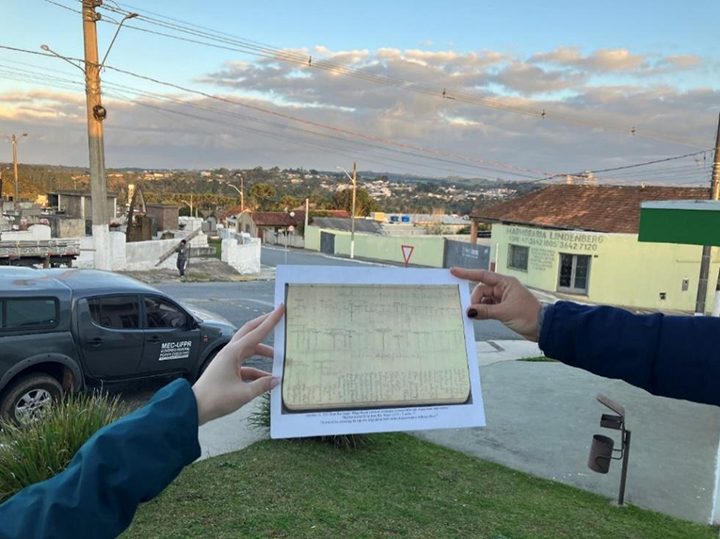
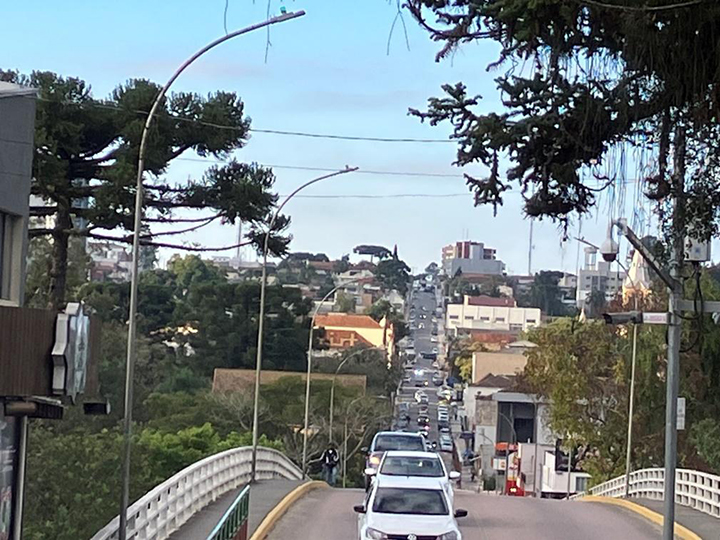
We went up and down the streets of Rio Negro and Mafra until sunset, looking for the views Muir sketched. There were Araucarias scattered on the ridges we could see from the streets above town near the cemetery in Rio Negro, and in the views north from Mafra, across the modern highway bridge. Things have changed, time and development has intervened, but Araucarias are still scattered here, albeit sparsely, near and far. Although we think we were close to where Muir must have sketched, we couldn’t convince ourselves that we were standing exactly in his footsteps, but were satisfied that we had followed him in spirit. We drove into the fading day toward Curitiba.
_______
For Muir, who had planned to spend only about half a day in Rio Negro, things didn’t quite go as expected: “6:00 P.M. and no sign of train. Fine rosy, purple evening. Train came at last. We left Rio Negro at 7:30 and arrived at Currityba at 2:30 on the morning of the 26th. Had miserable night on the cars. Went to hotel and had three or four hours sleep. The Ar. distributed as far as I could make out in the starlight most of the way.” The next morning, he wrote that he “Walked about town after a late breakfast. Paid my respects to Mrs. Smith, charming lady born in the redwood region of California, at Eureka. Bade goodbye to all my Ar. [Araucaria] friends, Bouchet, Smith, Perry, Goodyear, and felt very lonely.”
The next day, October 27th, he was off on another leg of his journey: “Started at 6:30 A.M. for Paranaguay.”26 After a breathtaking train ride up and over the Araucaria-clad Serra do Mar mountains to the Paraná coast, Muir stayed in a hotel near the docks at Paranaguá on the night of October 27th, waiting for a ship to Montevideo, Uruguay the next day. “Steamer was advertised to sail at 3:00 P.M. today, but did not sail until after midnight. Long waiting in the dark at wharf and out in the Bay on the tender. Not allowed to get aboard until after nine o’clock. Good little ship,” Muir wrote.27 In brief letter to daughter Helen from Paranaguá, he wrote: “Darling Helen Hope you’re all well. Am just leaving Paranagua for Montevideo on steamer Sirio. Have had glorious time in forests of Araucaria Braziliensis, in state of Parana & am quite well.”28
From Brazil, Muir went to Santiago, Chile, by train—as had been his original plan—and from there to the central Andes, where he finally managed to find the other South American species of Araucaria he was seeking. As had been the case in Brazil, however, when he arrived in Santiago, he did not really have much information about where to go to find the “monkey puzzle” forests, and again, through a combination of serendipity and determination, managed to eventually see them. It is those “footsteps” that my son and I managed to retrace during trips in 2012, 2013, and 2016.29
In a letter to his friend Katherine Hooker from Montevideo, Uruguay, written on December 6, Muir summarized his experiences seeing both Araucaria species: “From Rio I sailed to Santos & thence struck inland & wandered most joyfully a thousand miles or so mostly in the State of Parana through millions of acres of the ancient tree I was so anxious to find Araucaria Braziliensis. Just think of the glow of my joy in these noble aboriginal forests, the face of every tree marked with the inherited experiences of millions of years. From Paranagua I sailed for Buenos Aires, Crossed the Andes to Santiago Chile, thence south four or five hundred miles. Then straight to the snowline & found a glorious forest of Araucaria imbricata the strangest of the strange genus.” In the same letter he said: “It’s perfectly marvelous how kind hundreds of people have been to this wanderer & the new beauty stored up is far beyond telling.”30
That last sentence to Katherine Hooker could serve as a fair summary of my trip to follow Muir’s footsteps in Brazil. Many people, new scientific colleagues and now friends, were very helpful and kind. And the new beauty stored up is far beyond what I can tell here.
Notes & Sources
All materials from the John Muir Papers at the University of the Pacific’s Holt-Atherton Special Collections and Archives noted below are provided as a courtesy and are ©1984 Muir-Hanna Trust.
With special thanks to Professor Marcos B. Carlucci, ecologist and Araucaria conservation expert from the Federal University of Paraná in Curitiba, for arranging and facilitating the field trip to Tres Barras and Rio Negro and for linking me with other scientific contacts at universities in Santa Catarina and Rio Grande do Sul states.
- “Araucariaceae” https://en.wikipedia.org/wiki/Araucariaceae
- On a tour to Australia and New Zealand in 1904, he made deliberate detours from a more direct route of travel to see Araucaria bidwellii, the “bunya pine,” in the rainforests of Queensland, and another giant member of the Araucaria family near Dargaville on the North Island of New Zealand, the kauri, Agathis australis.
- Photo by Herbert W. Gleason. Photo courtesy of Golden Gate NRA, Muir Woods Collection, GOGA 32470.0292 https://npgallery.nps.gov/AssetDetail/90CB7734-CFBC-89D6-0D2B98943D4C0C16 (public domain)
- John Muir examining large piece of petrified wood, Petrified Forest, Arizona, circa 1905. https://digicoll.lib.berkeley.edu/record/42534?v=uv#?xywh=-328%2C-56%2C2123%2C1205
- Andrea Wulf, The Invention of Nature: Alexander von Humboldt’s New World. New York: Alfred A. Knopf, 2015, pp.167-168
- Donald Worster, A Passion for Nature: The Life of John Muir. Oxford University Press, 2008, p. 118; Michael P. Branch, “John Muir’s Travels to South America and Africa,” The John Muir Newsletter, Fall 2001 https://scholarlycommons.pacific.edu/jmn/66/ )
- Letter from John Muir to Helen [Muir Funk], 1911 Mar 31. https://scholarlycommons.pacific.edu/muir-correspondence/6042/
- Worster, 2008, p. 442
- John Muir Journals (1867-1913), John Muir Papers, Holt-Atherton Special Collections and Archives, University of the Pacific Library. ©1984 Muir-Hanna Trust. https://scholarlycommons.pacific.edu/jmj/
- I’m grateful to Mike Wurtz, curator of the Holt-Atherton Special Collections and Archives, for permission to use the copyrighted images from Muir’s Brazil journal in this essay.
- See:
- https://www.brucebyersconsulting.com/tracking-john-muir-to-the-monkey-puzzle-forests-of-chile/
- https://www.brucebyersconsulting.com/following-muirs-route-in-sketches-and-photos/
- https://www.brucebyersconsulting.com/documenting-forest-change-at-the-muir-site/
- https://www.brucebyersconsulting.com/following-up-on-following-john-muir-to-the-monkey-puzzle-forests-of-chile/
- https://www.brucebyersconsulting.com/all-i-came-to-seek-ive-found-closing-the-loop-with-john-muir-in-california/
- https://www.brucebyersconsulting.com/wp-content/uploads/2023/03/Byers-B.A.-2022.-Following-John-Muir-to-the-Araucaria-Forests-of-Chile.-Patagon-Journal-No.-25-pp.-44-53.pdf
- Harold W. Wood, Jr. 2026. John Muir in India: A Naturalist’s Journey from the Great Banyan to the Snowy Himalaya. Planet Patriot Press, www.planetpatriot.net/books Quote is from p. 28
- One of my models for that technique is Paul Spencer Sochaczewski’s book An Inordinate Fondness for Beetles: Campfire Conversations with Alfred Russel Wallace on People and Nature Based on Common Travel in the Malay Archipelago (Singapore: Editions Didier Millet, 2012); and maybe some element of Woody Allen’s Midnight in Paris…
- Letter from John Muir to [Charlotte H.] Kellogg, [1911?] Feb 11.
https://scholarlycommons.pacific.edu/cgi/viewcontent.cgi?article=7029&context=muir-correspondence In the letter Muir refers to the Andean species of Araucaria he wanted to see in Chile. which he called “Araucaria imbricata,” but whose scientific name is now Araucaria araucana. His letter suggests he intended to go to Chile first, then Brazil. - Letter from John Muir to Osborn [family], 1911 Sep 20.
https://scholarlycommons.pacific.edu/muir-correspondence/6176 - In Michael P. Branch, John Muir’s Last Journey: South to the Amazon and East to Africa, Unpublished Journals and Selected Correspondence. Washington, DC: Island Press, 2001, p. 80, footnote 8, Branch gives a biographical sketch of John Casper Branner [erroneously given as “Professor Banner” in the JMP transcription of Part I Image 45 https://scholarlycommons.pacific.edu/jmj-all/3301/; Branch’s transcription corrected it to “Branner”]
Maybe what Muir learned from Prof. Branner, his botanist friend from Stanford University, WAS what was known to American botanists at the time. Muir must have assumed he would have to go up the Uruguay River to the highlands where the photos Branner showed him of A. angustifolia were taken. Branner had made an expedition to Brazil in 1889 with Alexander Agassiz, Harvard glaciologist Louis Agassiz’s son; Alexander had been a member of the 1896 Forest Commission, along with young Gifford Pinchot, and Muir (informally). Muir must have known Branner through the Agassizes and his Harvard connections (Muir was given an honorary degree there in 1886). - “Natural range of Araucaria angustifolia” https://conifersociety.org/conifers/araucaria-angustifolia
- Letter from John Muir to Helen [Muir Funk], 1911 Oct 10. https://scholarlycommons.pacific.edu/muir-correspondence/6181/
- John Muir Journal, Oct. 10, 1911, Part I Image 44: https://scholarlycommons.pacific.edu/jmj-all/3300/) & Journal, Oct. 10, Part I Image 45: https://scholarlycommons.pacific.edu/jmj-all/3301/).
Note: The following text is NOT in Muir’s handwriting in his journal entry on Oct. 10, Part I Image 45 https://scholarlycommons.pacific.edu/jmj-all/3301/, although the JMP digital transcription, and Michael P. Branch, John Muir’s Last Journey: South to the Amazon and East to Africa, Unpublished Journals and Selected Correspondence. Washington, DC: Island Press, 2001, p. 80 have it included in October 10th entry.
“The only definite information that I have of the Araucaria braziliensis, which I was determined to find, was from Prof. Banner [sic… but this is not a transcription of anything I find that Muir wrote—he might have written “Branner,” as Branch, 2001, did in footnote 8, p. 80], who showed me two photographs taken somewhere on the upper Uruguay River, in which a few groups of these trees were seen in the general forest of the region. But on my way from Para to Rio I made the acquaintance of Mr. Harell, who, with a party of eight or ten, was on his way to work on a large mill that was about completed in the State of Parana, situated about three or four hundred miles to the west of Curytiba. I inquired what kind of timber they were going to cut and they said that it was called Brazilian pine, but that he had never seen any of those trees. He told me, however, that from a description he got from one of the mill men who had been in that work there, they were trees that were perhaps one hundred feet high without limbs; that the limbs were all in a bunch at the top. I had little doubt from this description that they were the trees I was in search of, and said I would be very glad to go to the mill in their company if they would allow me, and he said he had no doubt that I would be welcome there.”
Where is this text from? So far, it is a mystery. - Worster, 2008, pp. 182-183
- Journal, 15 October, Part I Image 53: https://scholarlycommons.pacific.edu/jmj-all/3309/ and Part I Image 54: https://scholarlycommons.pacific.edu/jmj-all/3310/ )
- The digital transcription of Muir’s Journal at Part I Image 57: https://scholarlycommons.pacific.edu/jmj-all/3313/, and in Branch, 2001, says Smith was “superintendent of the mill,” but Muir’s own writing in the journal does not say this, so I’m not sure where the JMP transcriber or Branch got that information or why it was added. Even Muir seemed not to be quite sure of Mr. Smith’s title. The lumber “mill” and the railroad were a conglomerate enterprise, so even Muir’s confusion at the time may have been justified.
- Journal, Part I Image 54. https://scholarlycommons.pacific.edu/jmj-all/3310/
- Journal, Part I Image 56: https://scholarlycommons.pacific.edu/jmj-all/3312/
- Journal, Part II Image 2: https://scholarlycommons.pacific.edu/jmj-all/3323/
- Journal, Part II Image 3: https://scholarlycommons.pacific.edu/jmj-all/3324/
- Journal, Part II Image 5: https://scholarlycommons.pacific.edu/jmj-all/3326/
- Journal, October 28, Part II Image 7. https://scholarlycommons.pacific.edu/jmj-all/3328/
- Letter from John Muir to Helen [Muir Funk], 1911 [Nov ?]. https://scholarlycommons.pacific.edu/muir-correspondence/6195/
- See note 10 for links to blogs about following Muir in Chile
- Letter from John Muir to [Katharine Hooker], 1911 Dec 6. https://scholarlycommons.pacific.edu/jmcl/8657/


