
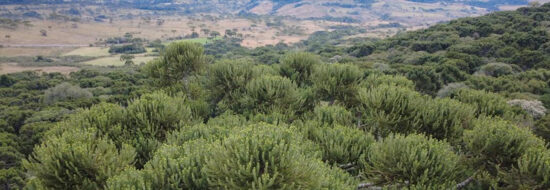
We had spent the morning with Dr. Rafael Barbizan Sühs, a landscape ecologist working at the Federal University of Santa Catarina in Florianópolis. Rafael’s research focuses on the Araucaria-grassland mosaic of southern Brazil’s high plateau, the planalto, and he had taken us to see some of his research sites in the Parque Nacional de São Joachim.
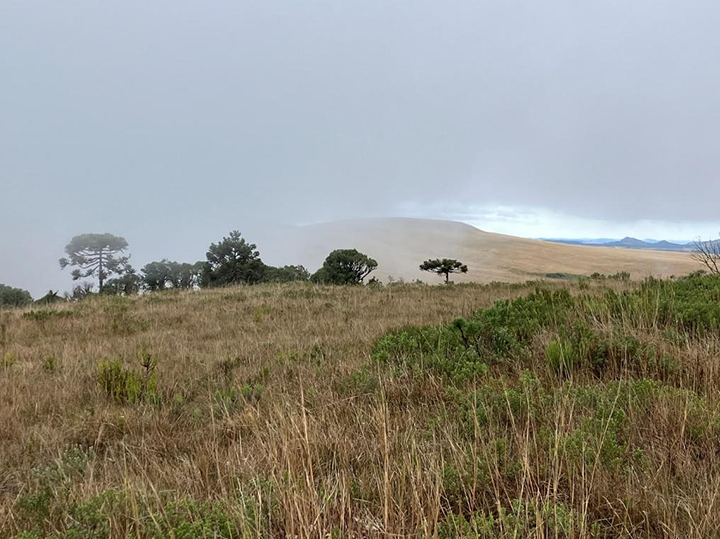
It is big, beautiful high country, and the long views and tawny grasses of the June winter season reminded me of the savannahs of East Africa—the Serengeti plains and Ngorongoro Crater, for example. Rafael explained that this steppe was once full of a megafauna of giant sloths, gomphotheres, horses, camels, saber-toothed cats, dire wolves, and more—something like that of the suite of big animals that still survives in Africa—before their extinction at around the time human hunter-gatherers arrived here, which is thought to be as early as 25,000 years ago.
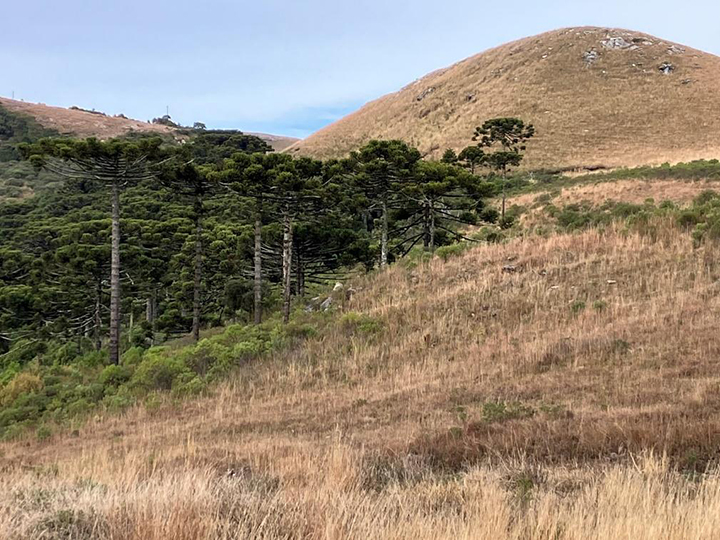
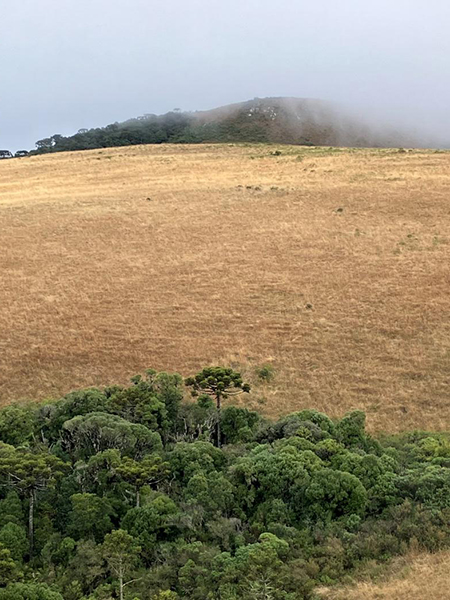
After the morning exploration we stopped at the old house within the national park that now serves as a research station for ecologists from the Federal University of Santa Catarina. The place was bustling with perhaps a dozen researchers, mostly graduate students. A wonderful lunch of entreveiro was simmering on the woodstove, a common traditional recipe of the region, made with beef, sausage, pinhões, onion, tomato, bell pepper, and other vegetables.

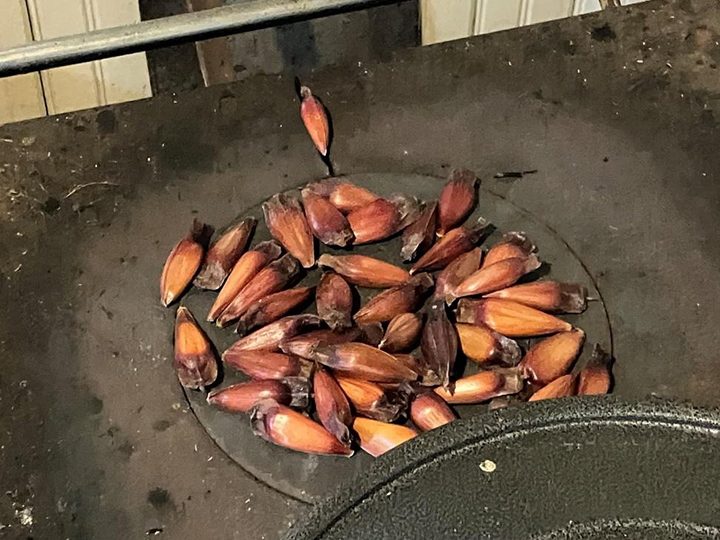
As an appetizer, Rafael tossed fresh pinhões (Araucaria nuts) on the hot stovetop, stirring and toasting them. It brought out a roasted nuttiness that is missing in the boiled version—the more common way of cooking them.
We had only one day to spend with Rafael, and the afternoon program involved a choice: We could go to see what is purported to be the largest remaining Araucaria angustifolia in all of Brazil, located on a private fazenda (ranch), or drive an hour or so in the opposite direction to Urupema, where at this season large flocks of a parrot called the charão (or papagaio charão) gather to feast on Araucaria nuts. That sounded wonderful, and we watched some videos of the spectacle online.1 It was tempting.
But the Big Tree was closer, and we were thinking “What would John Muir do?” As I said in another blog, and in the several talks I gave in Brazil describing why John Muir came to Brazil at the age of 73, he loved big, old trees. We decided he would go see the Big Tree—and so would we.
Rafael opened the gate at Fazenda Pinheirão, and we drove to the main house on the property.
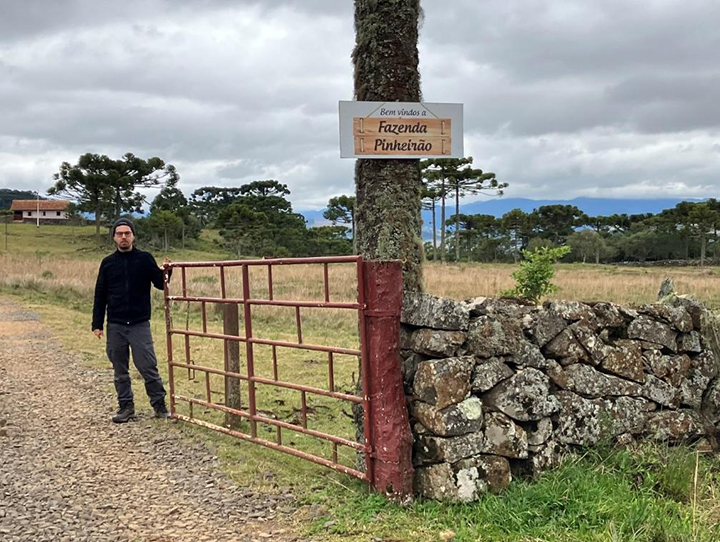
Pinheiro means “pine tree” in Portuguese, and even though Araucarias are not true pines (although they are relatives, some of the earliest conifers to evolve even before the true pines) they are called pinheiro. Adding the ending ão to a word in Portuguese makes whatever that is bigger, bolder, stronger, more important, or more impressive. So a pinheirão is a big Araucaria. Locally, the Big Tree is just called Pinheirão, and the fazenda takes its name from the tree.2 After being offered a quick coffee by the property owners, we climbed aboard two small ATVs to travel the muddy backroads through the forest to the Big Tree.
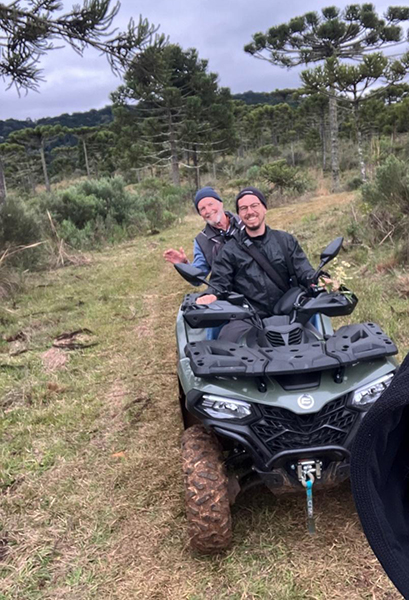
(Rafael driving, Bruce waving), June 2026
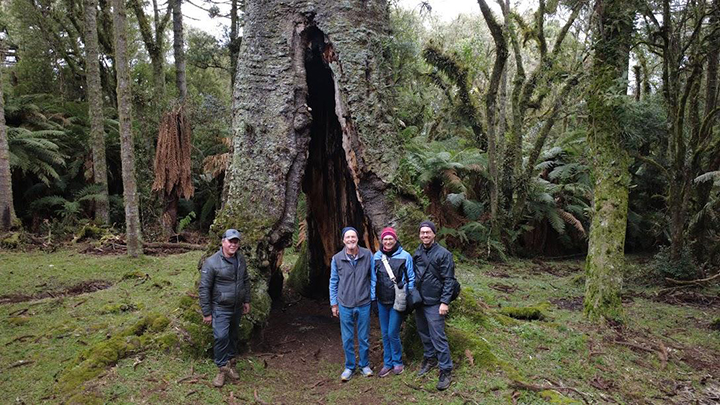
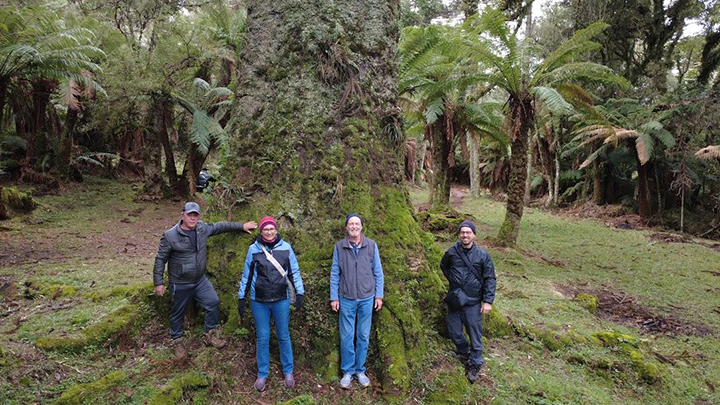
It is indeed a big, old, very impressive tree. It’s height, measured in various ways, is about 40 meters, or 130 feet; and the tree is about 10 meters, or 30 feet, in circumference (the distance around the tree, measured at chest height, as foresters do). Pinheirão is estimated to be about 800 years old.
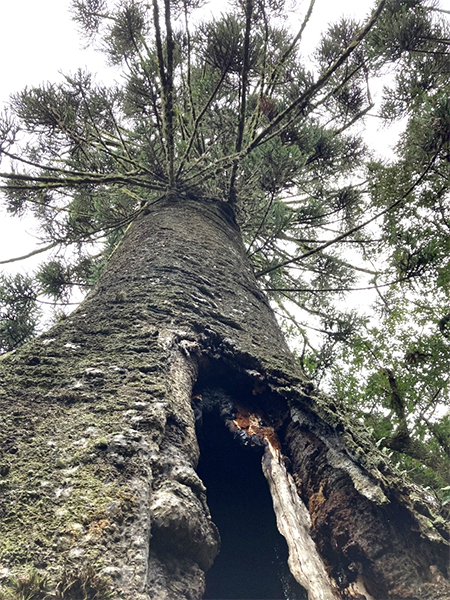
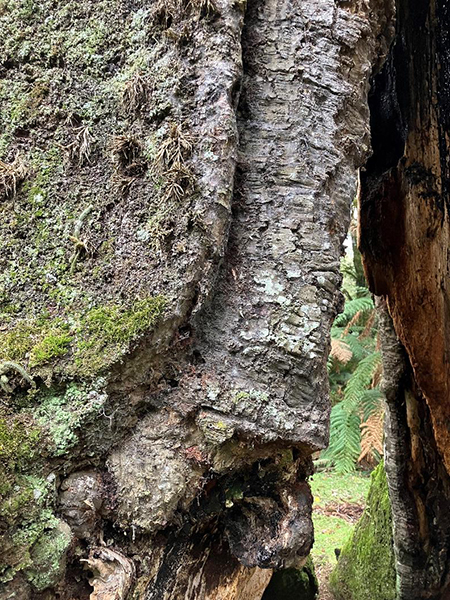
The Big Tree shows the signs of an eventful life. The huge trunk is split at the base, creating a tall tunnel that passes completely through the tree. The edges of the main opening to this tunnel show telltale signs of wounding by fire; healing curls of wood outline the opening, created as the tree tried to repair and grow over the damaged cambium under the thick bark. Several episodes of this wounding and healing are visible—perhaps three layers of healing curls. But at some point a fire must have broken through, burning inside the tree for awhile and carving the tunnel, but still not killing the tree. The fazenda owners worry about the structural integrity of Pinheirão; how much longer can the Big Tree keep standing?
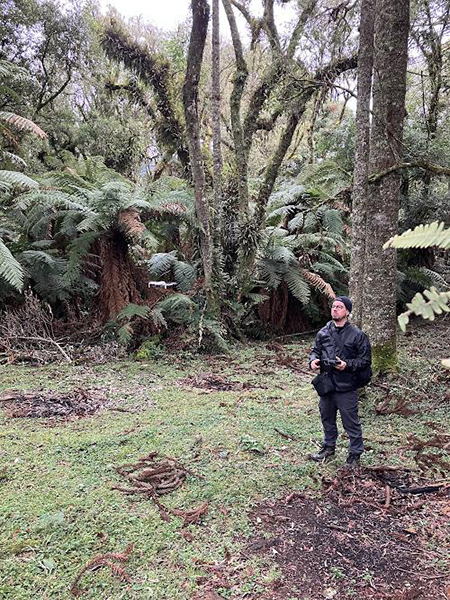
Rafael had brought his small drone along, and with permission from the fazenda owner, soon had it unpacked and airborne. At first, he navigated it around the base of the tree, taking photos of our group to give a sense of its size. Then he piloted it up the tree, aiming carefully through gaps in the understory canopy.

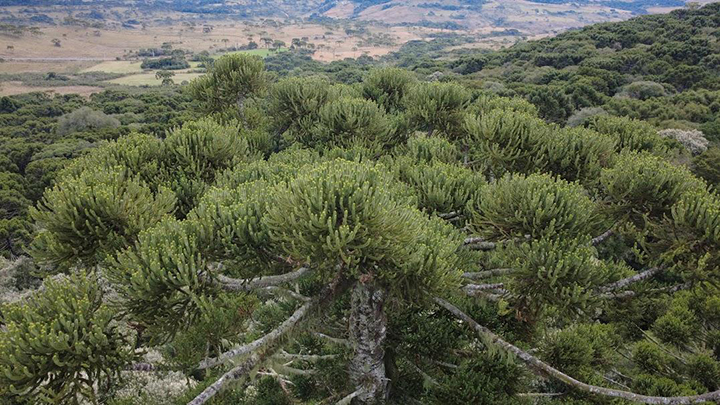
Soon the drone’s camera was giving a bird’s-eye view of top of the Big Tree, the solid but much shorter canopy of Araucaria forest surrounding it, and the grasslands on the ranches beyond. It was the view a charão, the Araucaria parrot, might have.
OK, John, let’s fly up to the top of the biggest Araucaria remaining in Brazil!
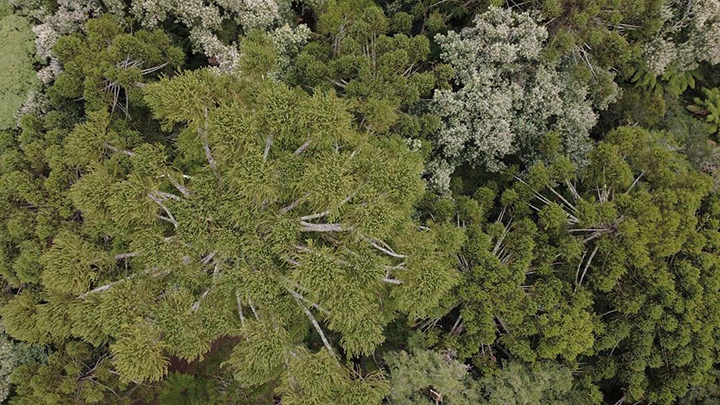
And now we’d better come back down to Earth!
_______
I’m not completely sure what Muir would have thought of being able to fly like a bird up to the top of the largest Araucaria angustifolia in Brazil, but I suspect he would have been delighted. He was always a tinkerer and inventor, and drones would surely have fascinated him. And he was always on a quest for new and novel viewpoints from which to see nature and experience it.
When I first started reading Muir’s descriptions of his adventures, one story that especially captured my imagination was “A Wind Storm in the Forests.”3 He described his experience climbing to the top of a big tree during a howling windstorm in the northern Sierra Nevada Mountains. First published in the November 1878 issue of Scribner’s Monthly, Muir later included it as a chapter in his first book, The Mountains of California, which was published in 1894. It will be best just to pull excerpts from Muir’s own skillful writing to sketch the story, rather than paraphrasing it:
“One of the most beautiful and exhilarating storms I ever enjoyed in the Sierra occurred in December, 1874, when I happened to be exploring one of the tributary valleys of the Yuba River. Instead of camping out, as I usually do, I then chanced to be stopping at the house of a friend. But when the storm began to sound, I lost no time in pushing out into the woods to enjoy it. For on such occasions Nature has always something rare to show us, and the danger to life and limb is hardly greater than one would experience crouching deprecatingly beneath a roof.
[In the high winds] colossal spires 200 feet in height waved like supple goldenrods chanting and bowing low as if in worship… The force of the gale was such that the most steadfast monarch of them all rocked down to its roots with a motion plainly perceptible when one leaned against it. Nature was holding high festival, and every fiber of the most rigid giants thrilled with glad excitement.
I drifted on through the midst of this passionate music and motion, across many a glen, from ridge to ridge; often halting in the lee of a rock for shelter, or to gaze and listen. Even when the grand anthem had swelled to its highest pitch, I could distinctly hear the varying tones of individual trees—Spruce, and Fir, and Pine, and leafless Oak… Each was expressing itself in its own way—singing its own song, and making its own peculiar gestures—manifesting a richness of variety to be found in no other forest I have yet seen.
Toward midday, after a long, tingling scramble through copses of hazel and ceanothus, I gained the summit of the highest ridge in the neighborhood; and then it occurred to me that it would be a fine thing to climb one of the trees to obtain a wider outlook and get my ear close to the Aeolian music of its topmost needles. But under the circumstances the choice of a tree was a serious matter. One whose instep was not very strong seemed in danger of being blown down, or of being struck by others in case they should fall; another was branchless to a considerable height above the ground… while others were not favorably situated for clear views. After cautiously casting about, I made a choice of the tallest of a group of Douglas Spruces [Pseudotsuga menziesii, Douglas-fir] that were growing close together like a tuft of grass, no one of which seemed likely to fall unless all the rest fell with it. Though comparatively young, they were about 100 feet high, and their lithe, brushy tops were rocking and swirling in wild ecstasy. Being accustomed to climb trees in making botanical studies, I experienced no difficulty in reaching the top of this one, and never before did I enjoy so noble an exhilaration of motion. The slender tops fairly flapped and swished in the passionate torrent, bending and swirling backward and forward, round and round, tracing indescribable combinations of vertical and horizontal curves, while I clung with muscles firm braced, like a bobolink on a reed.
In its widest sweeps my tree-top described an arc of from twenty to thirty degrees, but I felt sure of its elastic temper, having seen others of the same species still more severely tried—bent almost to the ground indeed, in heavy snows—without breaking a fiber. I was therefore safe, and free to take the wind into my pulses and enjoy the excited forest from my superb outlook. I kept my lofty perch for hours, frequently closing my eyes to enjoy the music by itself, or to feast quietly on the delicious fragrance that was streaming past.
We all travel the milky way together, trees and men; but it never occurred to me until this storm-day, while swinging in the wind, that trees are travelers, in the ordinary sense. They make many journeys, not extensive ones, it is true; but our own little journeys, away and back again, are only little more than tree-wavings—many of them not so much.
When the storm began to abate, I dismounted and sauntered down through the calming woods.”
If he loved swinging around at the top of a hundred-foot-tall Douglas-fir, I’m sure Muir would have been thrilled to fly up to the top of the largest Araucaria still standing in Brazil. When he walked through the old-growth Araucaria forest around the Lumber camp and mill, he would have been under a canopy of such giants, some probably even taller.
In the windstorm, Muir described each species of tree “singing its own song.” Later, writing about one of those species, ponderosa pine (Pinus ponderosa), he claimed that “This species gives forth the finest music to the wind. After listening to it in all kinds of winds, night and day, season after season, I think I could approximate to my position on the mountains by this Pine-music alone.” When he wrote about the windstorm and pine-music, Muir had not yet seen an Araucaria. That would come more than a quarter-century later.
I thought of Muir one day in Brazil, walking through an Araucaria forest on the edge of Cânion do Itaimbezinho, a spectacular canyon cut into the highland plateau of southern Brazil near the town of Cambará do Sur, in the Aparados da Serra National Park. It was late afternoon, with winter sun slanting in from the northwest, and it was windy. I was alone on the trail—my hiking companions were far enough ahead I couldn’t hear their voices—and I suddenly noticed, with surprise and then pleasure, the wind-song of the Araucarias. Muir described something of the quality and what he called “temper” of ponderosa pine music, which I’ve heard many times, and love (I grew up in the pine woods of the Pajarito Plateau in northern New Mexico). I realized that this Araucaria sound was different—different than ponderosa pine, or any tree-song I had heard before. It must be the sharpness of the needles, their clusters on the outreaching branches, and the wind-raking whirl of their crowns. Ah! Wonderful! And I wondered: what would Muir have thought of this wind music? How would Araucaria music compare with his first favorite, ponderosa pine? If he could tell his position in the Sierra by the pine music, could he tell where he was on Earth from hearing this Araucaria song?
_______
As we wound down the tracks through forest and across grassland pastures after visiting the Big Tree, we heard their squawking calls and saw their silhouettes against the overcast sky: Parrots! Flocks of Amazona petrei, the charão, were here too at Fazenda Pinheirão, feasting in the treetops on the ripe Araucaria cones. The flock landed in the trees on both sides of the track we were on; we stopped and watched and listened until they suddenly swirled on in a restless, hungry wave. We had killed two birds with one stone… uh, no, let’s not use that saying about achieving two desired outcomes at once when one of them was a bird! We didn’t have to choose between seeing the Big Tree and seeing the parrots after all.
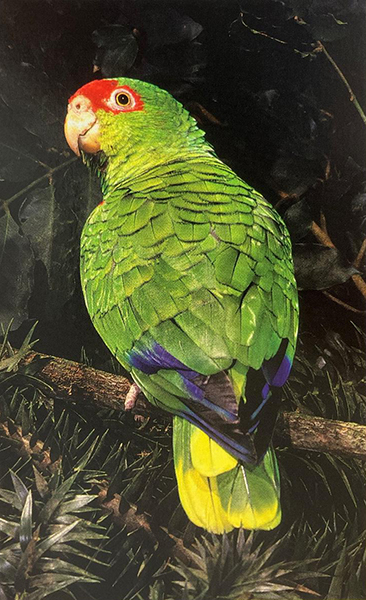
(Source: Koch and Corrêa, 2010, p. 72)4
The charáo is found only in areas with Araucaria forests, linked with these trees in a tight symbiosis. Its main food is Araucaria nuts, although it also depends on fruits of Podocarpus, another ancient Gondwanan conifer species found in these forests. Araucaria pinhōes ripen at somewhat different times, and in different places within the overall range of the species, providing the moving parrot flocks with food from roughly April to July. When the parrots open the cones, some pinhões fall to the ground without being eaten, where they may germinate naturally. Or, perhaps more often, they may be scavenged by Azara’s Agouti (Dasyprocta azarae), a medium-sized rodent called the cutia in Brazil; cutia often bury the nuts in dispersed caches for later consumption. This behavior, called scatter hoarding, is a major source of Araucaria regeneration, because sometimes the cutia, for one reason or another, doesn’t return to dig up and consume all of its caches, and some of the forgotten seeds sprout. Another key Araucaria seed disperser, the Azure Jay (Cyanocorax caeruleus) may join the charão flocks in feasting on the opened cones. Azure Jays are also scatter-hoarders, and like cutias don’t always make it back to every buried cache.
For related stories see
- Following John Muir to Brazil in Search of the Paraná Pine (August 3, 2026)
- The Araucaria War (August 21, 2026)
Notes & Sources
- “Largest Concentration of Parrots in Southern Brazil,” Planeta Aves, YouTube, May 8, 2025
- “Parana Araucaria ‘Pinheirão’ at Fazenda Pinheirão in Pericó, Santa Catarina, Brazil” https://www.monumentaltrees.com/en/bra/santacatarina/saojoaquim/19547_fazendapinheiro/ ;
“Pinheirão: Largest Araucaria tree in Brazil” https://www.viagensecaminhos.com/maior-araucaria-do-brasil/ - John Muir, “A Wind-Storm in the Forests,” Chapter X in The Mountains of California. https://www.gutenberg.org/cache/epub/10012/pg10012-images.html#chap10
- Zig Koch and Maria Celeste Corrêa. 2002. Araucária: A Floresta do Brasil Meridional; The Meridional Brazil Forest. Olhar Brasiliero: Curitiba.


