

We arrived at the Municipal Museum of History and Heritage in Três Barras, located in the old railway station, just before its closing time of 5:00 p.m. on a Tuesday in early June. The enthusiastic manager, who had been expecting us earlier, was happy to keep the museum open for our gang of curious out-of-town and international visitors. Dozens of historic black-and-white photos from the era of Muir’s visit in October, 1911, gave a vivid impression of what he must have seen and experienced.
And it led me to an unexpected discovery about the foreboding context of his visit. In following Muir’s 1911 route in Brazil, I had only expected to see what had changed as far as what he saw and sketched in the Araucaria forests around Três Barras and Rio Negro. I hadn’t expected to discover that, one year after his trip, there was a four-year war, from 1912 to 1916, over those same forests, the Guerra do Contestado or Contestado War, which reshaped the history of the region. The logging situation around Três Barras was the spark for the war, and I think it could accurately be called the “Araucaria War” or perhaps the “Araucaria Forest War.” It pitted small-scale, local, subsistence colonists and farmers, many of them Indigenous or of mixed-race heritage—called caboclos or cafuzos in Portuguese—against large landowners, including, and perhaps especially, the American-owned Southern Brazil Lumber & Colonization Company, owners of more than a million acres of land rich with old-growth Araucaria angustifolia, who were backed by the government of the state of Paraná at that time.1
Although Muir was a guest of the Americans at their new sawmill in Três Barras one year before the war began, he gives no hints at all in his journal or correspondence that he sensed any political tension in the area. He seems to have been completely oblivious to this incipient conflict.
But how could that be? On both ecological and sociopolitical fronts, I would have thought he would at least have noticed something amiss in and around Três Barras, after staying for more than a week with the American loggers in what he described as their “hospitable camp,” and exploring the “most interesting forest I have seen in my whole life.” A year after Muir’s visit, lumber company security forces, numbering in the hundreds, fought alongside the army against the rebelous caboclos. I would have thought that the Muir I thought I know from his writing, and from his conservation leadership in the United States, would have been seriously disturbed by what he saw in Brazil, at least enough to mention it in his notes at the time. But no. Nada.
I didn’t expect to uncover this—what is, for me, a real mystery about Muir.
I’ll explain later, but the devastation of the once-vast Araucaria angustifolia forests in southern Brazil perhaps holds the record for the worst industrial-scale deforestation in the world—or close to it. Muir wrote that he had a “glorius time” wandering the woods as that deforestation was just beginning, and leaving Curitiba for his onward journey, was sad to leave his new lumbermen acquaintences, whom he called “my Araucaria friends.” What was he thinking?
_______
To understand the context of the Contestado War and Muir’s 1911 visit to Paraná, we need first to look back at the history of colonization of the area over the previous century.
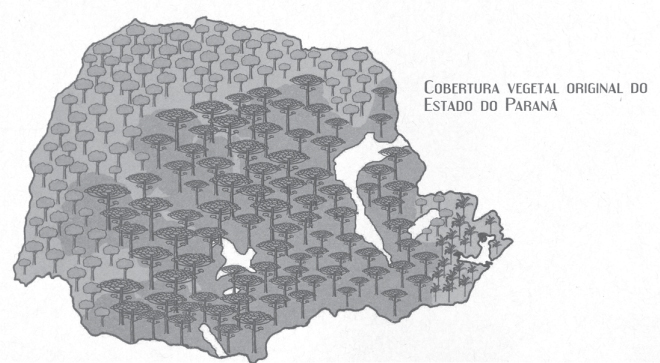
(Source: Araucarilândia,2 p. 52)
Until about 1800, the vast forests on the highland plateau—the planalto—of southern Brazil, in what are now the states of Paraná, Santa Catarina, and Rio Grande do Sul, were virtually untouched. Araucaria angustifolia was the keystone species of this ecosystem, structuring its ecological relationships. In Paraná at that time, forests covered more than 84% of the territory.3 Cattle trade between Rio Grande do Sul and São Paulo across the highlands and through the forests gradually led to settlements along the routes used by the cattle drivers. From those nuclei, mixed-race and Indigenous homesteaders (caboclos and cafuzos) spread into the mostly intact forest. These small-scale subsistence farmers grew crops and raised livestock for their own consumption, used Araucaria pinhões (nuts) as a staple food source, and depended on wood for houses and fuel. Some harvested yerba mate (Ilex paraguariensis) from the forest understory, which could be sold to dealers supplying the market in the Rio de la Plata region (e.g., Buenos Aires and Montevideo). (The Portuguese farm family Muir spent the night with in Porto Amazonas was probably this kind of frontier family, based on his description of their lifestyle.)
Until the late 1800s, forest resources were mostly used locally. The mountain wall that isolated the coast from the interior plateau prevented any significant timber trade until the opening of the Estrada da Graciosa (Graciosa Road) in 1873, a wagon road that connected Curitiba to Antonina, and the construction of a railway between Curitiba and Paranaguá in 1885. The Araucaria lumber export trade grew rapidly; by 1900 there were already 64 sawmills in Paraná, and more than 100 by 1906, employing about one-quarter of the industrial workers in the state.4
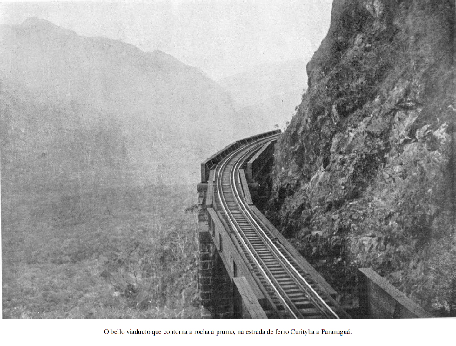
de ferro Curityba a Paranaguá. The beautiful viaduct that curves around the sheer rock face on the Curitiba-Paranaguá railway.” (Source: Araucarilândia,2 p. 36)
Into this picture, in 1906, came American capitalist entrepreneur Percival Farquhar. Farquhar, through his holding company, the Brazil Railway Company, acquired control of the São Paulo-Rio Grande Railway Company, creating the potential to link São Paulo with growing cities on the plateau and coastal ports in southern Brazil through the railroad network. Taking a lesson from the railroad magnates of the United States a half-century earlier, Farquhar pitched a deal to the government of Brazil: I build the railroad, you give me land on either side of the tracks in compensation. To seal the deal with Farquhar, the government declared the lands “vacant and uninhabited,” although they knew they were occupied by the homesteading caboclos, who seldom had legal title to their land. Although this violated an earlier Brazilian land law, the Paraná courts sided with the government and the Brazil Railway Company.
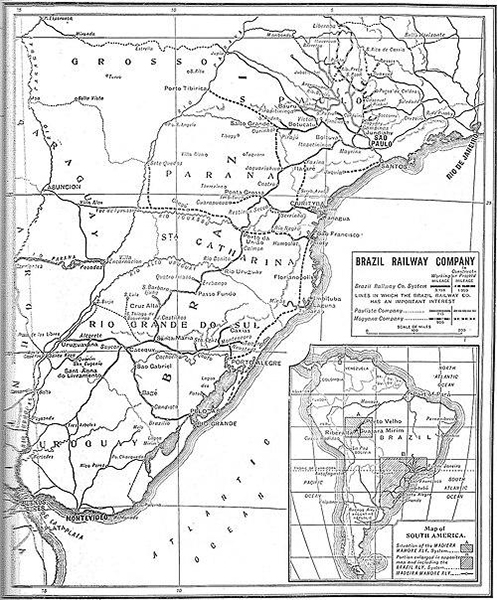
The Brazil Railway Company was given a strip of land 15 kilometers wide on either side of its railroad routes—that’s 30 kilometers total, or almost 20 miles wide, with the tracks in the middle. “Anticipating the enormous profit he could obtain from exporting timber from the dense, centuries-old Araucaria forests in the region on land he would receive as a donation from the federal government, under the terms of the railway concession contract, he [Farquhar] had previously founded the Southern Brazil Lumber & Colonization Company, which became known as Lumber.”6 The company quickly focused on an area of about 6,700 square kilometers near the junction of the Iguaçu River and its tributary the Rio Negro, near Três Barras, where it began to establish the mill Muir visited. Farquhar’s railroad already passed through the town of Rio Negro, which could be reached by river steamer, and a railroad connection was soon built to the mill. Muir wrote in his journal that the “Parana Lumber Company” owned “nearly a million acres of Araucaria forest.” In fact, Lumber’s land concession was much larger, about 1.65 million acres, and in addition to the land the company owned outright, it negotiated logging leases of 20 to 25 years with other private landowners in the area. According to a 1927 US Forest Service study, “The Parana pine [i.e., Araucaria angustifolia] lumber industry is of comparatively recent development. Although this pine has been cut for many years, it is only recently that the industry has been of more than local importance. Its expansion has been due largely to the introduction of American machinery and to the entrance of a large concern, the Southern Brazil Lumber & Colonization Co., into the trade. This large concern produces about 30 percent of the lumber cut in Brazil.”7
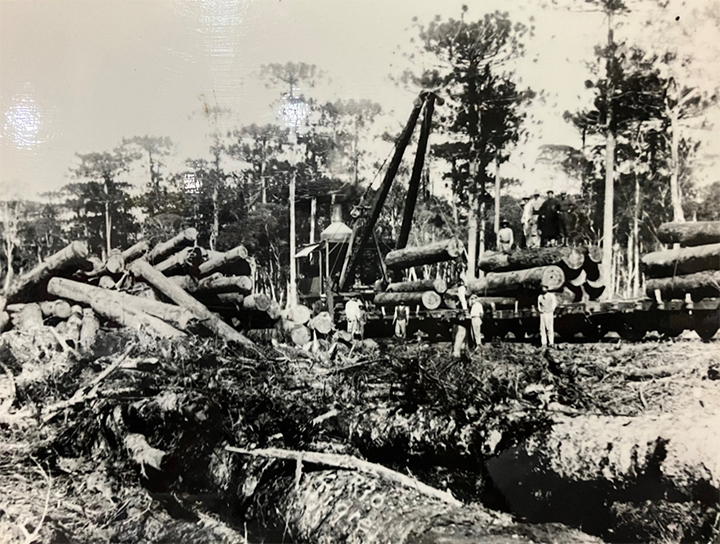
(Source: Municipal Museum, Três Barras)
Farquhar’s Brazilian railway venture clearly seems to be modeled on the railroad land-grants system that operated in the United States from 1850 to 1871, and which created the railroad magnates of the Gilded Age: Cornelius Vanderbilt, Jay Gould, Edward Harriman, J.P. Morgan, Leland Stanford, and others. The American railroad-building venture capitalists were given land as payment for their infrastructure investment: “The land grants were made in twenty- or fifty-mile strips, with alternate sections of public land given for each mile of track built. The federal government kept the in-between sections, which were open to homesteaders and land speculators.”8 The railroad companies then lured immigrants from a disintegrating Europe to these “vacant” lands—recently stolen from Native American tribes as the Euro-American population grew and spread west—with the promise of cheap land.
_______
With that background, it should come as no surprise that Farquhar’s Lumber Company had a dramatic and devastating effect on both the ecology and socio-economic situation of the area.
Ecologically, the Araucaria region changed rapidly from being almost entirely forested to almost entirely deforested. Marcos Carlucci and his coauthors put it this way in a scientific paper on Araucaria conservation: “The Araucaria Forest, found at high altitudes in southern Brazil, is one of the country’s most threatened forest ecosystems. It is estimated that only about 3% to 13% of the formation’s original cover remains, a result of the intense logging pressure it endured over several decades. This devastation stems from the fact that Araucaria angustifolia and certain associated species served as Brazil’s primary source of timber for much of the 20th century”9
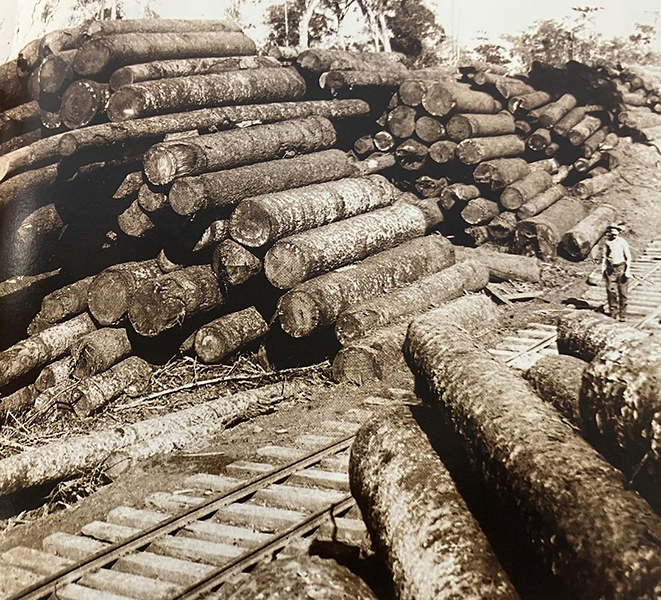
(Source: Koch and Corrêa, Araucária,3 p. 93)
The Três Barras mill, just being established and expanded when Muir visited, became an Araucaria Auschwitz: millions of trees went in over the next several decades and were processed with industrial efficiency; they left by rail as sawn lumber.
One source made the link between the ecological and social consequences of the Lumber operation, saying: “Throughout southern Brazil, the Araucaria Forest was devastated at a similar pace. However, it was in the Contestado region, in Santa Catarina, that the destruction was the most impressive and frightening for the cruelty imposed on people and nature by the powerful Brazil Railway Company, parent company of Southern Brazil Lumber and Colonization Company.”10 Another source noted that: “While Farquhar cannot be entirely absolved of blame for the tragic events that unfolded in the Contestado region, the federal government, by donating to the Brazil Railway Company, through a public service concession contract, lands that had been occupied for centuries by Brazilians as if they were no man’s land, stands out as the main cause of the serious conflicts that occurred there.”11
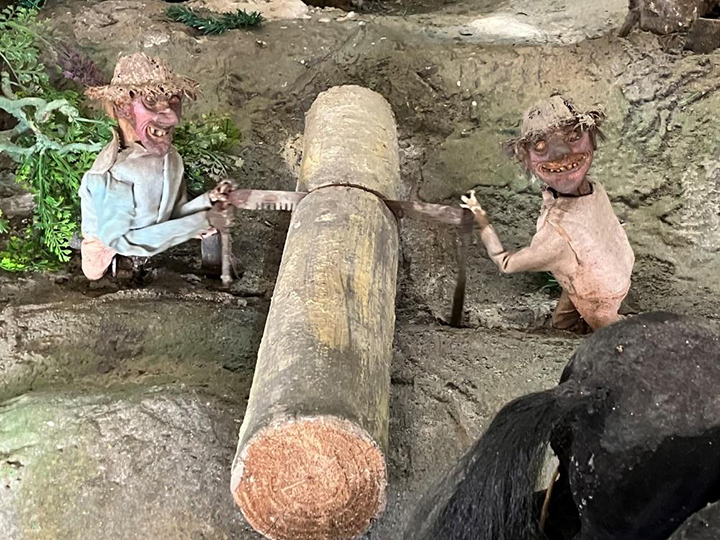
at Parque Temático HISGEOPAR,12 June 2026
I mentioned at the beginning of this essay that it was sparked by my visit to the Municipal Museum in Três Barras, and the information provided there about the relationship between the Lumber Company and the Contestado War. The photo below shows the Museum’s summary of the issues that drew my attention.
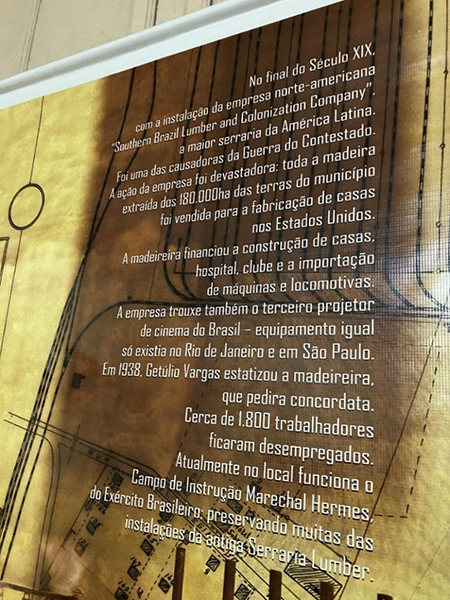
Here is a translation:
At the end of the 19th century,
with the installation of the North American company
“Southern Brazil Lumber and Colonization Company,”
[the company opened] the largest sawmill in Latin America.
It was one of the causes of the Contestado War.
The company’s actions were devastating: all the timber
extracted from the 180,000 hectares of land in the
municipality was sold for the construction of
houses in the United States.
The lumber company financed the construction of houses,
a hospital, a club, and the importation
of machinery and locomotives.
The company also brought the third cinema projector
to Brazil—similar equipment
only existed in Rio de Janeiro and São Paulo.
In 1938, Getúlio Vargas nationalized the lumber company,
which had filed for bankruptcy.
Around 1,800 workers
lost their jobs.
Currently, the site houses
the Marechal Hermes Training Camp of
the Brazilian Army, preserving many of the
facilities of the former Lumber Sawmill.13
There were about 40,000 people living in the area centered on Três Barras, and the Lumber Company expelled thousands of these settlers. It hired its own security forces, including gun-slinging American guards, who intimidated and threatened local residents and its own workers, enforcing what were essentially the company’s own laws on its huge property.
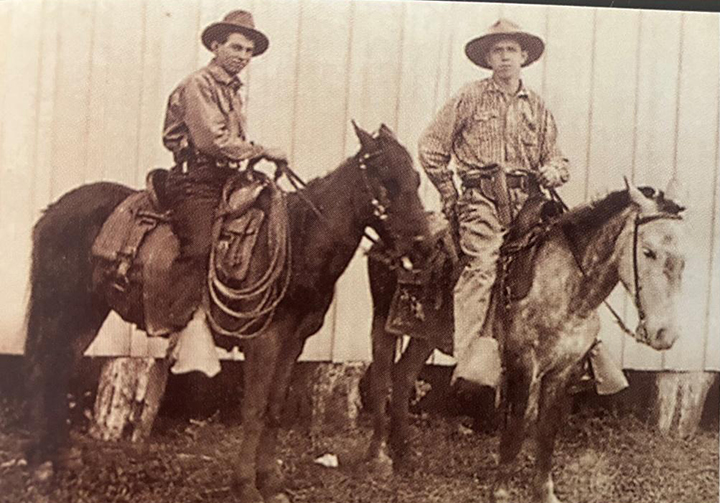
(Source: Koch and Corrêa, Araucária,3 p. 91)
The settlers were pushed farther into surrounding forest areas. “This expulsion added to the resentment generated by the abandonment of the region by the governments of Santa Catarina and Paraná. Both claimed ownership of the territory, but until the border dispute was resolved, neither wanted to invest in or assist the communities. This led to widespread dissatisfaction that resulted in bloody conflicts over several years. However, in December, 1913, the episode known as the Taquaruçu Uprising truly began the conflict involving the region’s population.” About 12,000 civilians armed themselves to fight government army troops and Lumber’s security forces in successive battles. When the Contestado War finally ended in 1916, about 10,000 civilians, including women and children, and about 1,000 army troops had been killed.14 Although drowned in scale by World War I with which it partly overlapped, the Contestado War was not insignificant; the Gaza War, now in its third year in 2026, has seen about 78,000 people killed so far.
Resistance to Lumber in the Guerra do Contestado was partially inspired and led by Catholic monks, especially José Maria de Santo Agostinho. This linkage of economic justice with religion seems to me an early version of later “liberation theology,” which arose from Catholic roots in Latin America, including Brazil.15
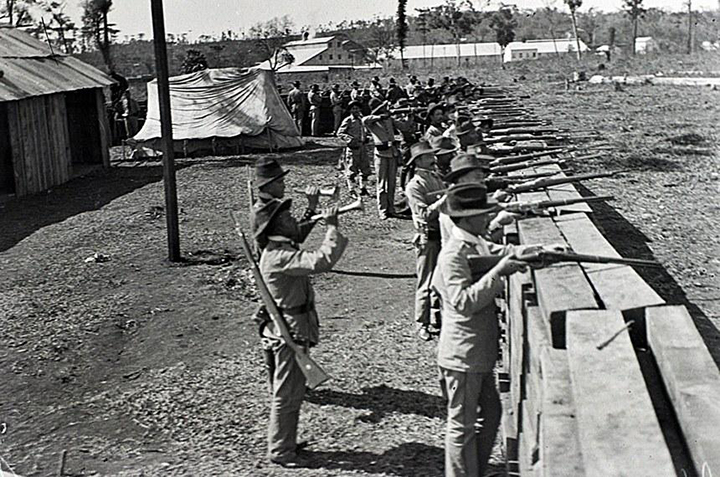
With the end of the Contestado War, Lumber intensified its action as a colonizing company. Any small farmer who wished to buy land in the area that had already been logged was forced to agree with the company’s terms. Finally, in 1938, Brazilian President Getúlio Vargas nationalized the company and the former concession area became the property of the Brazilian Government.
_______
After visiting the Municipal Museum in Três Barras and learning about the ecological devastation and social conflict spawned by the lumber company that hosted Muir, we were curious to see what the area where he may have wandered looks like today. To do that, we headed for the Floresta Nacional de Três Barras, the Três Barras National Forest, the next morning. The conservation area is now managed by the Brazilian government conservation agency, the Chico Mendes Institute for Biodiversity Conservation (usually abbreviated as ICMBio). The national forest’s management objectives include biodiversity conservation, ecological restoration, and sustainable uses of forest resources.18
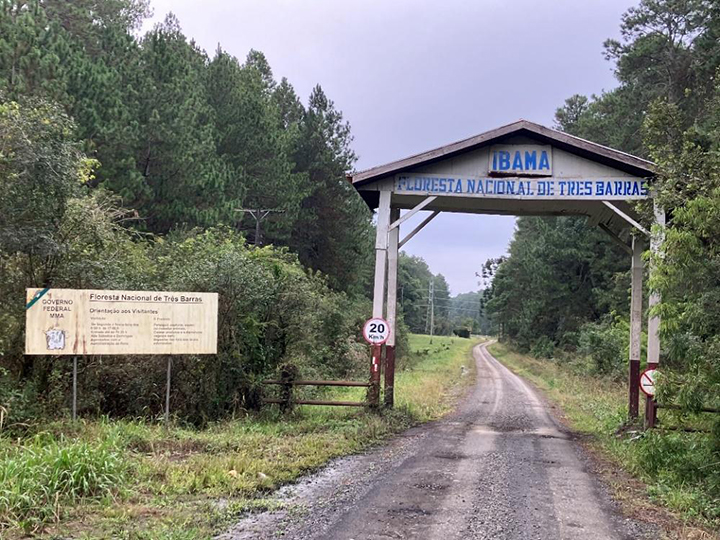
When President Getúlio Vargas nationalized Lumber’s lands in 1938 [some sources say 1940], they were at first managed by the Brazilian Army, but in 1944 part of the area was set aside for forestry activities. That area gradually evolved through changing management structures and objectives into its current form, the Três Barras National Forest. An adjacent area is still owned by the army, the Field Marshall Hermes Training Camp.19
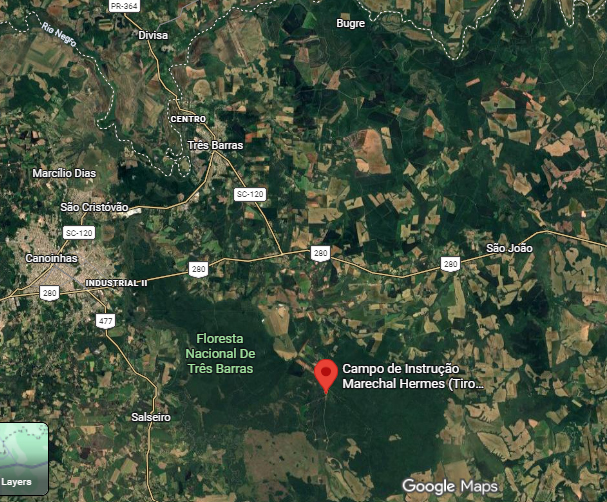
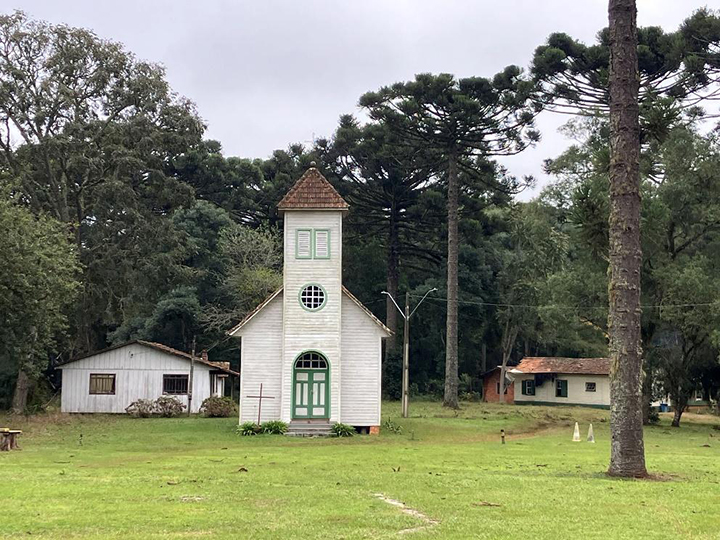
Professor Marcos Carlucci from the University of Paraná had arranged our visit to the Floresta Nacional de Três Barras, and we were greeted by a few staff members, one of whom, Álvaro, promptly led us off on a leafy track into an area of the least-disturbed and most-natural Araucaria forest near the headquarters. We climbed over fallen trunks and limbs here and there and attempted to keep our footing as we also were tempted to look up and marvel at the canopy of the forest.
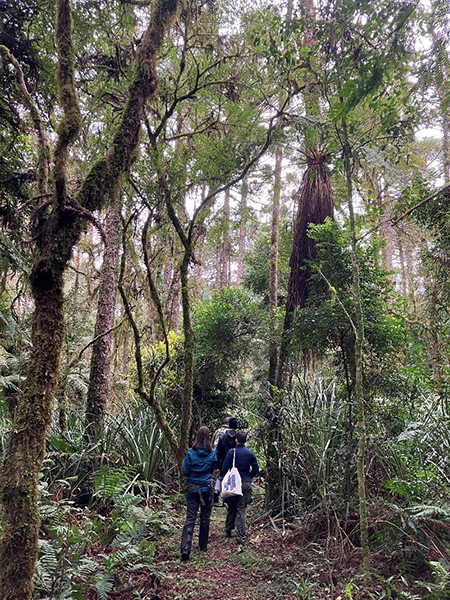
Not only were there giant old Araucaria here, forming most of that canopy, but also huge imbuia, Ocotea porosa, and cedro, Cedrela odorata—both valuable timber species, and both also the targets of the American lumbermen. Tree ferns were common in the understory, spreading over us like giant dinosaur-age umbrellas; one, Dicksonia sellowiana, is rare and endangered and commonly called xaxim (pronounced “zha-zheem”). This forest is extremely diverse, with perhaps 150 species of trees (woody plants taller than shrubs with diameters at breast height of a few inches, at least). Scientific names and common names were flying around so fast that I couldn’t keep up with them; I’m more of a zoologist than a botanist in my biological training, and I grew up in Rocky Mountain forests that had, maybe, a dozen species of trees. So, my head was spinning, but I was amazed and smiling as my botanist-guides greeted old friends: “Oh look, here is Drimys angustifolia! It’s in the Winteraceae… If you crush its leaves, you get a peppery smell… Winteraceae are definitely part of the Antarctic flora, the Gondwanan flora…” And “Oh, look here! This is yerba mate, Ilex paraguariensis—in the holly family. It’s common in the understory of these Araucaria forests…” Look, “Podocarpus lambertii, another Gondwanan plant! We call it pinheiro bravo, but like Araucaria, it’s not a pine…”
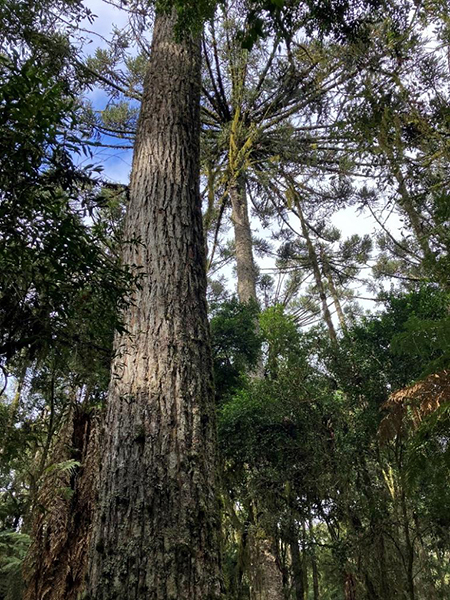
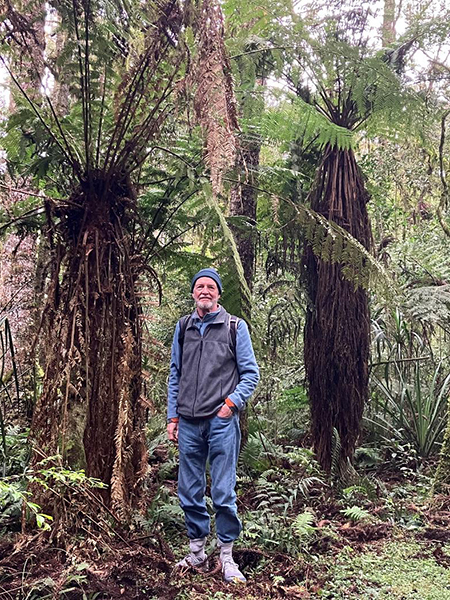
From Dicksonia to Drimys and more, one message that sunk in was that many species in this forest, not only Araucaria, are found only on the southern continents that once were joined together for a while in Earth’s tectonic history before they drifted away from the supercontinent of Pangaea to form Gondwana. The plants and trees rode along and evolved; their relatedness shows that this is a “Gondwanan” plant assemblage, or flora. John Muir had seen another species of the tree fern Dicksonia, as well as Podocarpus, in New Zealand, which was once also part of Gondwana. I could almost join him in calling this the “most interesting forest I have seen in my life,” as he said about these woods around Três Barras.
Did Muir ever walk exactly where we walked? We won’t ever know, but it’s possible. And if he didn’t, the forest we saw would have looked quite like the one he saw.
_______
And now, finally, back to the initial question about what Muir could have been thinking during his 1911 visit to the geographical and causal epicenter of the Contestado War, only one year before it began.
Ecologically, in terms of the area of natural forest cut and percentage left intact, what happened to the Araucaria forests around Três Barras is significantly worse than what happened to the coast redwood forests of California. Muir Woods National Monument, created by President Theodore Roosevelt in 1907 and named in honor of Muir because of his efforts to protect some natural remnants of America’s original ecosystems, was a late, last-gasp effort to protect a small area of old-growth redwoods near San Francisco. That was only four years before Muir went to Três Barras and watched an American logging company begin to do what American loggers had done to Sequoia sempervirens starting in the 1850s, after the California Gold Rush. Muir saw the beginning of the Araucaria logging at Três Barras. I can’t imagine that he was not asking himself the question: How would that end, here in Brazil? But in his journal he did not.
One hypothesis about why Muir didn’t understand the seriousness of the threat to Brazil’s Araucaria forests is that he was astonished by their vast extent and intactness. In his journal he made a short note about the region and the extent of Araucaria the American lumbermen were there to cut—he may have gotten this information from Mr. Smith, who would have wanted to impress him:
Paranaguá, port of State of Parana.
Curytiba capital 60,000 pop.
3,000 ft. above sea. 4 hrs by train from port.
30,000,000 Araucaria trees in state.21
Thirty million Araucaria trees in Paraná! It sounds like a lot.
His journal entry about meeting the Americans on the ship from Rio seems me to express surprise at the size of their forest holdings: “Sailed for Santos at five o’clock this afternoon. Found Mr. Harell, who introduced me to Mr. Bouchet, Superintendent of Parana Lumber Company, owning nearly a million acres of araucaria forest…” [emphasis added]. Maybe Muir was persuaded by his contacts that Brazil’s Araucaria forests were so vast that they were not really threatened by the scale of logging he saw, that somehow cutting this million-acres in central Paraná would be fine, and that eventually some of this ecosystem would be preserved and protected somewhere else. If so, he should have known better, from his experience in California.
Muir would have been well aware that a million acres was an area larger than Yosemite National Park, which was 759,620 acres. And he would also have been aware that just before the California Gold Rush (1848-1855) there were about two million acres of coast redwoods in Northern California. Today, only about 5% of the old-growth redwood forests remain.22 Muir’s newfound “Araucaria friends” in Brazil were Californians, undoubtedly relatives or descendants of the loggers who had laid waste to his beloved redwoods. Mr. Smith, a California lumberman, was superintendent of the Três Barras mill, and his wife, Mrs. Smith, was described by Muir in his journal as a “charming lady born in the redwood region of California, at Eureka”—Eureka was the epicenter of coast redwood logging.
But wait a minute… I’ve been wondering what Muir could have been thinking of his Californian lumber friends, but there’s another side to the coin: What could they have been thinking about him? I can imagine Mr. and Mrs. Smith talking about their future, in, say 1908 or 1910:
“Well, honey, I don’t know what we’re gonna do! Those damn “preservationists” don’t want us to cut down trees, they seem to think trees are more important than houses! The president just locked up that beautiful stand of old growth north of San Francisco, prevented it from being cut by your uncle down there. Teddy made it into a “national monument,” whatever that’s supposed to mean, and named it after a guy called John Muir! He’s one of the founders of that damn preservationist group called the Sierra Club… don’t like logging, don’t like dams, don’t like progress! Maybe we’ll just have to consider that offer I got to go to Brazil with that new lumber company that’s cutting Parana Pine. Guess they don’t have as many of those preservationists down there…”
And then, a few years later, a guy named John Muir shows up on their doorstep in Três Barras, wanting to look at, measure, and draw some of those trees they were cutting. Whoops! They must have assumed he would be hostile to their logging enterprise, but… They turned him into a friend, or he turned them into friends, it seems. Puzzling, to say the least. What pops into my head is the old saying, “With friends like these, who needs enemies?”
But we should remember that Muir’s era was a time of rethinking and reorganizing the management of the remaining natural landscapes of the United States. The supposed dichotomy between utilitarian “conservation” and “preservation” doesn’t really take into account the complexity of the issues, and the often-told story that Muir’s views were opposed to and incompatible with those of his younger contemporary Gifford Pinchot is also an oversimplification.
A bit of background: Muir and Pinchot served together on the National Forest Commission,23 established by Congress in 1896 to assess the situation of western lands with an eye to designating more national forest reserves and protecting them for the long-term public good. The Commission was headed by Harvard botanist Charles S. Sargent, who invited Muir to join the commission as an adviser on their grand tour of western forests in the summer of 1896, although Muir was not an official member. Gifford Pinchot, a 31-year-old French-trained American forester who would later become the first chief of the US Forest Service, was an official commissioner. Sargent and Pinchot didn’t see eye to eye. Inspired by Muir’s writing and his defense of Yosemite, Sargent advocated “preserving” the forests in a wild state, while Pinchot, with his European forestry training, advocated “conserving” them for sustainable uses, including timber production. But Muir and Pinchot, who had met each other before, got along well. Although of quite different ages, they were the rebellious bad boys of the expedition, going off to sleep under the stars while the others huddled in their tents. During the tour, on July 26, 1896, Muir was interviewed in Portland by the Morning Oregonian. He said “Something must be done to preserve and perpetuate the forests, for the timber must ultimately be used. The forest must be able to yield a perennial supply of timber, without being destroyed or injuriously affecting the rainfall, thus securing all the benefits of a forest.” This sounds like a rather utilitarian view, although with a clear emphasis on sustainable uses, including for things like hydrological benefits to watersheds.
So, maybe Muir’s lack of criticism of the incipient logging he witnessed around Três Barras could be explained by his apparent tolerance for logging as an acceptable use of forest resources? But I somehow doubt he could look at the huge industrial-scale operation that was being established by Lumber and not be worried.
And there is another dimension—a social and political dimension—to puzzle over regarding Muir’s silence about the logging, for which we’ll also need a bit more background.
In 1872, Yellowstone National Park was established, the first national park in the U.S., and the world, only four years after Muir arrived in California. But by 1886, the thermal features, forests, and wildlife of Yellowstone were under serious threat from frontiersmen, hunters, trappers, and miners. Congress deemed the threat to the public’s interests so serious that it authorized the US Army to send troops to protect Yellowstone’s public resources. Soldiers chased poachers and fought forest fires, some of which were set by hunters to drive bison, elk, and other game out of the park so they could shoot them. The Army was so effective in protecting Yellowstone that in 1891, when it became clear that Yosemite, Sequoia, and King’s Canyon National Parks in California were threatened by local development and mismanagement, army troops were also sent there.24 (By 1916, the army “rangers” posted in our national parks had evolved into a new kind of paramilitary protective force, which metamorphosed into the National Park Service.)
Muir was thoroughly familiar with this history of protecting public interests in lands and their natural resources from destructive private interests in the United States, including with the use of military force. But in Paraná in 1911 he landed in the middle of almost the opposite situation. Clearly, the “public interest” of the thousands of settlers who inhabited the area was to protect and use the intact forest as they had been for a couple of centuries, locally and relatively sustainably. The destructive private interest that wanted to cut the forest and export its timber was an American company, and in this case the government of Paraná sided with Lumber, and sent the army to protect the (American) private interests against the true public interests. It’s almost the inverse of the situation with the national parks in the United States, with which—to say it again—Muir was thoroughly familiar. So, if he had had his social and political “antennae” up when staying at the “hospitable camp” at Três Barras, wouldn’t he have questioned the situation?
I would have to say yes. But the fact that he gives no hint of that questioning in his journal or correspondence is a missing puzzle-piece. And, I suspect, a piece of Muir’s history that will always remain missing, even if some eager historian tries to go down this rabbit hole in the future by an even deeper dive into his archives.
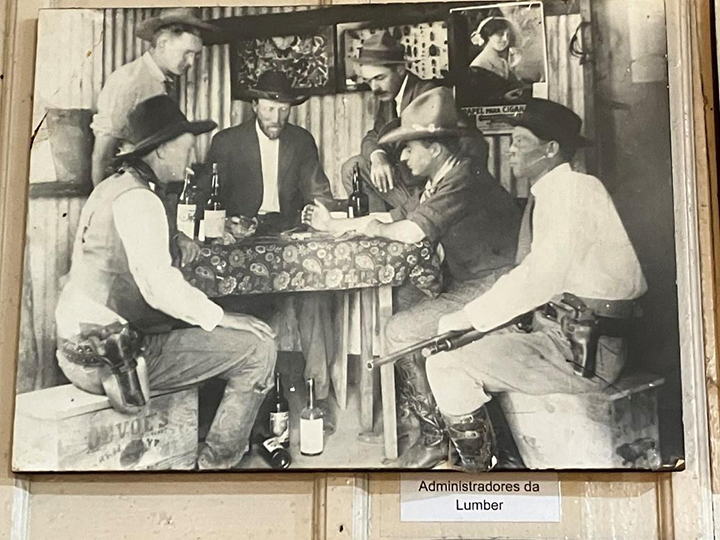
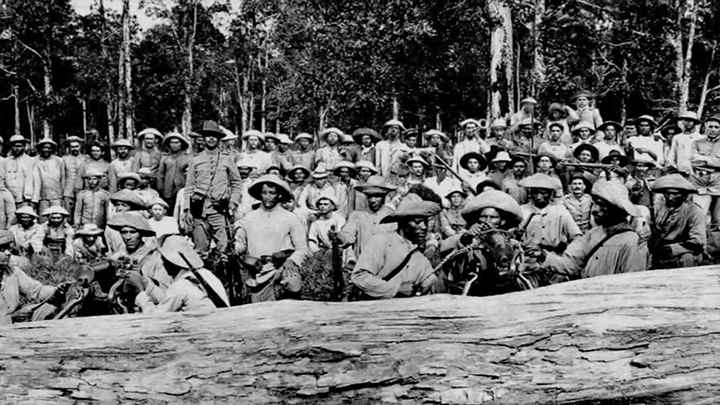
lumber concession Muir visited (Source: Municipal Museum, Três Barras)
Were any of these characters in the photo above—who look like scheming outlaws plotting a train robbery in a wild-west, Western movie—Muir’s “Araucaria friends”? Mr. Smith, is that you? Mr. Bouchet, uh… what are all these guns for…? We’ll probably never know. This was an example of American capitalist exploitation of global resources par excellence; there have been many others over the century or so since this example, to be sure. But I’m puzzled about Muir’s silence. Maybe some things are better left as mysteries.
Notes & Sources
See: “Following John Muir to Brazil in Search of the Paraná Pine” for the first episode of a series of essays about Muir in Brazil posted on my blog
With special thanks to the Municipal Museum of History and Heritage in Três Barras for their displays and historical photos, which preserve and bring to life the context in which we can situate Muir’s visit to the area in 1911.
- Wikipedia, “Contestado War” https://en.wikipedia.org/wiki/Contestado_War
- F.C. Hoehne. 1930. Araucarilândia. https://www.araucarilandia.com.br/wp-content/uploads/2021/01/Araucarilandia-Livro-e-Caderno-Suplementar-Web.pdf
- Zig Koch and Maria Celeste Corrêa. 2002. Araucária: A Floresta do Brasil Meridional; The Meridional Brazil Forest. Olhar Brasiliero: Curitiba. p. 150
- Koch and Corrêa, Araucária, p. 88
- Map of the Brazil Railway Company, Lloyd’s Greater Britain Publishing Company, Ltd. https://commons.wikimedia.org/w/index.php?curid=26834406
- Wikipedia, “Brazil Railway Company” https://pt.wikipedia.org/wiki/Brazil_Railway_Company
- Joseph C. Kircher. 1927. “Parana Pine Lumber Industry of Brazil.” United States Forest Service, Trade Information Bulletin No. 493. https://babel.hathitrust.org/cgi/pt?id=uiug.30112104063844&seq=1
- Wikipedia, “Railroad Land Grants in the United States”
https://en.wikipedia.org/wiki/Railroad_land_grants_in_the_United_States;
Bob Lettenberger and Angela Cotey. 2025. “Famous Tycoons Who Shaped America’s Railroad Industry” https://www.trains.com/trn/railroads/history/famous-tycoons-who-shaped-americas-railroad-industry/ - Marcos Bergmann Carlucci, João André Jarenkow, Leandro da Silva Duarte & Valério De Patta Pillar. 2011. “Conservação da Floresta com Araucária no Extremo Sul do Brasil; Conservation of Araucaria Forests in the Extreme South of Brazil,” Natureza & Conservação 9(1): 111-114, July 2011
For history of logging, see: Carlucci, M.B., Marcilio-Silva, V., Torezan, J.M., 2021. “The Southern Atlantic Forest: use, degradation, and perspectives for conservation.” In: Marques, M.C.M., Grelle, C.E.V. (Eds.), The Atlantic Forest: History, Biodiversity, Threats and Opportunities of the Mega-diverse Forest. Springer International Publishing, pp. 91–111. - Koch and Corrêa, Araucária, p. 150
- Wikipedia, “São Paulo-Rio Grande Railroad” https://pt.wikipedia.org/wiki/Estrada_de_Ferro_S%C3%A3o_Paulo-Rio_Grande
- Parque Temático HISGEOPAR https://123reserve.com/brazil/pr/litoral-do-parana/morretes/attractions/parana-encantado-hisgeopar is a spawling miniature diorama exhibit on the outskirts of Morretes that traces the economic history of the colonization and economic development of the state of Paraná, emphasizing the epochs or eras of economic development: gold, cattle, erva-mate, and lumber. And the role that transportation, especially the central role that the railroad between Curitiba and Paranaguá played in that history. Morretes was a stop on that railroad, and Muir passed through it on his way to Paranaguá, where he caught a ship to Montevideo and Buenos Aires.
- Translated from photograph. See also the history of Três Barras at: https://web.archive.org/web/20050318225826/http:/www.sc.gov.br/portalturismo/Default.asp?CodMunicipio=312&Pag=2
- Koch and Corrêa, Araucária, p. 150
- For deeper background, see: Todd A. Diacon. 1991. Millenarian Vision, Capitalist Reality Brazil’s Contestado Rebellion, 1912–1916. Duke University Press: Durham, NC. https://www.dukeupress.edu/millenarian-vision-capitalist-reality
- Wikipedia, “Infantry troops on the front line in the Contestado War” https://pt.wikipedia.org/wiki/Guerra_do_Contestado#/media/Ficheiro:Infantaria_na_linha_de_frente_no_Contestado.jpg
- Wikipedia, “Army soldiers defending sawmill during rebel attack in Três Barras (SC)” https://en.wikipedia.org/wiki/Contestado_War#/media/File:Contestado_tropa_Ex%C3%A9rcito.jpg
- Sources: Wikipedia, “Três Barras National Forest” https://en.wikipedia.org/wiki/Tr%C3%AAs_Barras_National_Forest;
Chico Mendes Institute for Biodiversity Conservation, “Três Barras National Forest” https://www.gov.br/icmbio/pt-br/assuntos/biodiversidade/unidade-de-conservacao/unidades-de-biomas/mata-atlantica/lista-de-ucs/flona-de-Três-barras - Jaisson Teixeira Lino, “Industrial heritage of a lumber company in Santa Catarina state, Brazil: considerations about industrial archaeology and the history of material culture.” J His Arch & Anthropol Sci., 2022; 7(3):144‒150.
- Google Maps screenshot: https://www.google.com/maps/place/Campo+de+Instru%C3%A7%C3%A3o+Marechal+Hermes+(Tiro+das+Armas+Coletivas)/@-26.1608391,-50.2844322,30326m/data=!3m1!1e3!4m6!3m5!1s0x94e7697237e13321:0x57d5027c3b1e6763!8m2!3d-26.2383518!4d-50.2485504!16s%2Fg%2F11b6210fy9?entry=ttu&g_ep=EgoyMDI2MDgwNS4xIKXMDSoASAFQAw%3D%3D
- John Muir Journal “August-October 1911, Trip to South America, Part I” Image 58, https://scholarlycommons.pacific.edu/jmj-all/3314/, John Muir Papers, Holt-Atherton Special Collections and Archives, University of the Pacific Library. ©1984 Muir-Hanna Trust
- National Park Service, Redwood National and State Parks, “Area History” https://www.nps.gov/redw/learn/historyculture/area-history.htm
“There was [were] about two million acres of old-growth redwoods in Northern California when Euro-American immigrants arrived in large numbers in the mid-18th century. When gold was discovered in northwestern California in 1850, the rush was on. By 1853, nine sawmills were at work in Eureka and large stands of redwoods began to disappear by the close of the 19th century. Land fraud was common, as acres of prime redwood forests were transferred from the public domain to private industry. Although some of the perpetrators were caught, many thousands of acres of land were lost in land swindles.” Sounds a lot like the situation around Três Barras when Muir visited… - “The National Forest Commission of 1896” https://alleghenyforestalliance.org/wp-content/uploads/2019/07/National-Forest-Commission-of-1896.pdf
- National Park Service, Sequoia & Kings Canyon National Parks, “History & Culture” https://www.nps.gov/seki/learn/historyculture/index.htm?mobile-app=true&theme=dark


August 23, 2026 4:37 pm
Thank you very much for this piece of Araucaria War. I have learnt a lot! Keep it up Bruce
August 25, 2026 5:01 pm
Thank you, Daulos! I’m glad if you enjoyed and learned from this piece. Did you know that John Muir visited Africa in early 1912, just after he was in South America? There, he went from Cape Town via Victoria Falls, and eventually to Mombasa, because he wanted to see baobabs! He really was a lover of big trees, and baobabs are some of the most wonderful trees in the world, I think you will agree! He never passed through Malawi, as far as I know… but I should check his route carefully, and maybe “re-enact” it some day.