
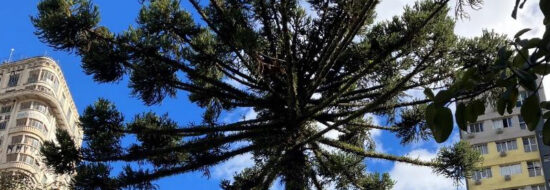
The primary goal of my recent trip to trip to southern Brazil was to go to the places John Muir visited in 1911 on his quest to see Araucaria angustifolia, one of the species of the ancient conifer family with which he was fascinated, and to see for myself what had changed compared with the sketches and descriptions in his journal. (See “Following John Muir to Brazil in Search of the Paraná Pine” for my essay about that search.)
Like Muir, I find the Araucaria family fascinating, so I also wanted to learn as much as I could about the ecology of the Brazilian species, Araucaria angustifolia, and its conservation. Before the trip I had reached out via the internet to a network of Brazilian ecologists working with Araucaria or in the Atlantic Forest ecosystem in which they are found, at first by googling keywords and identifying Araucaria researchers through their publications. That pre-trip networking led to invitations to speak about Muir and his Araucaria quest at three universities: the Federal University of Paraná, in Curitiba, and the federal universities in Santa Catarina, in Florianópolis, and Rio Grande do Sul, in Porto Alegre. During the question period after my talk in Porto Alegre,1 someone asked me about my impressions of the status of Araucaria and its conservation from my travels so far. By then I’d driven through a fair part of Araucaria country in the three southern states where the species is found; I’d been to national parks and private protected areas, to research sites with forest scientists, and seen Araucarias everywhere across the highland landscape on farms and in cities, in remnant patches, and as lone trees in farm fields.
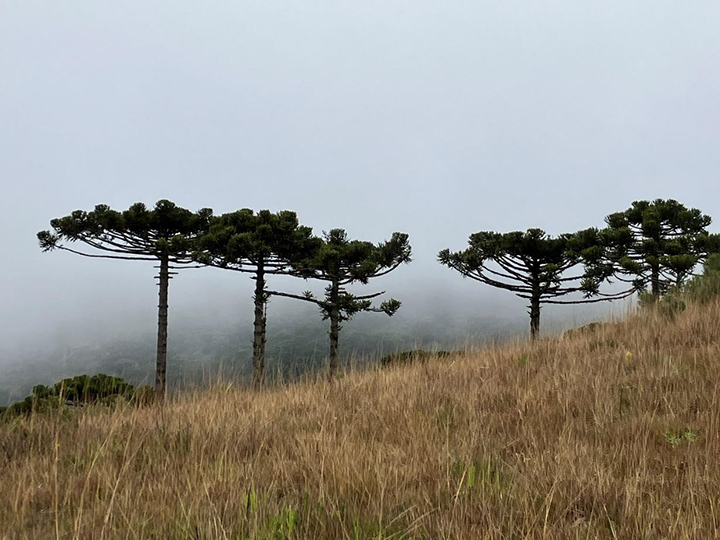
The answer popped into my head spontaneously, and I said “I think people here love those trees!” I immediately saw many affirmative nods from the audience. I think it is true: Brazilians who live in Araucaria landscapes love Araucaria. Maybe one explanation is their unique shape; it’s iconic and a symbol of the region. Maybe this is a kind of “imprinting” on the natural ecosystem where a person grows up, a deep, emotional bonding to place. Some of the ecologists I met said, more or less, that they somehow felt a calling to study Araucaria ecosystems; it just somehow felt right.
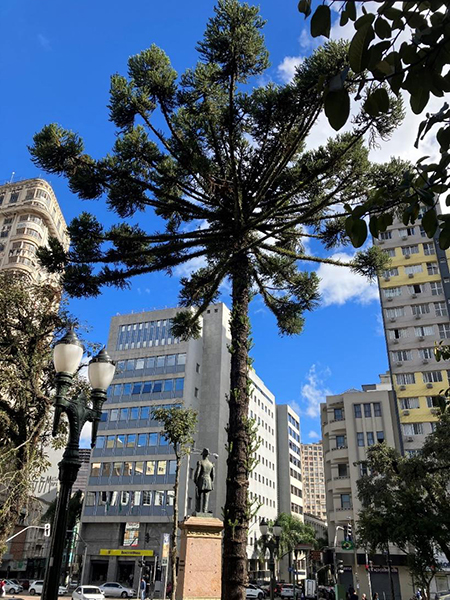
Cathedral of Our Lady of Light of the Pines, June 4, 2026
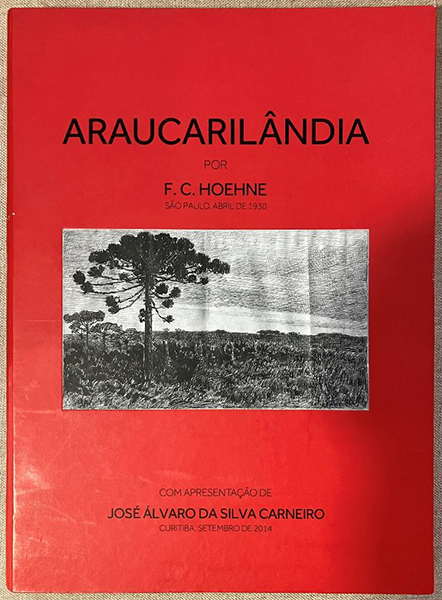
For the title of this essay, I commandeered the title of a beautiful old book: Araucarilândia. The book, by F.C. Hoehne, was first published in São Paulo in 1930, and republished in 2014 with additional commentary. A lovely woodcut of a lonely Araucaria graces the cover. Thanks to the miracles of modern technology, the entire book is available online, and although in Portuguese, I (and anyone) can read the parts I want to read using Google Translate.
I assumed “Araucarilândia” meant “Araucaria Land,” or “Land of Araucaria,” but to my ear it has a deeper ring: like “Greenland”—big and mysterious—or like “Alice in Wonderland”—fantastical and adventurous; or something of both. The author’s “Explanation of the Title” says this, reinforcing my intuition:
To the south—beyond the mountain range known as the Serra do Mar, where the plateau begins … Indigenous peoples had their “Curiirama” or “Curityba”: the land of the pine trees. They sought out this vast region when the pine nuts ripened, gathering them for food and hunting the mammals and birds that flocked there for the same reason. Paraná—the heart of this territory defined by the abundance of Araucaria angustifolia—adopted and preserved the beautiful Guaraní name, bestowing it upon its capital city. “Curityba”—meaning a profusion or cluster of pines—a fitting name for the capital of this “Araucaria-land.” Araucaria-land boasted forests and groves of this pine species, its defining characteristic. Although Araucaria predominated, it coexisted with other trees, shrubs, and numerous animal species; together, they formed a symbiosis—a fascinating mutual association—that could rightly be distinguished as an exceptional and unique biotic community.2
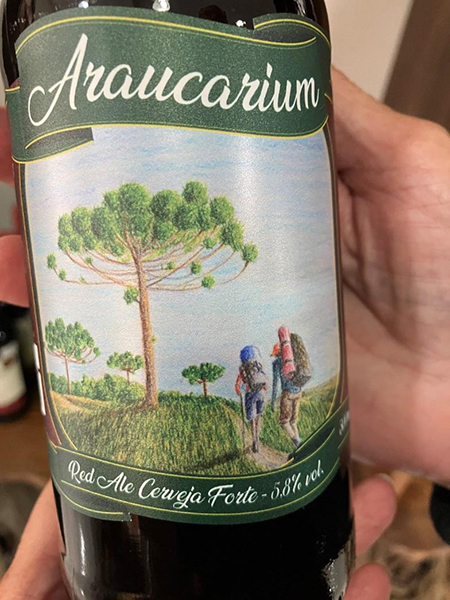
Yes: Araucarilândia is a symbiotic ecological landscape. A bioregion with Araucaria angustifolia as the keystone species. An interdependent biotic community, in the sense that Aldo Leopold used the term, in which humans are only one member. Let’s look at some of the synergies, and maybe go down a rabbit hole or two, looking for the Red Queen or the Azure Jay, the Cheshire Cat or Yerba Mate!
______
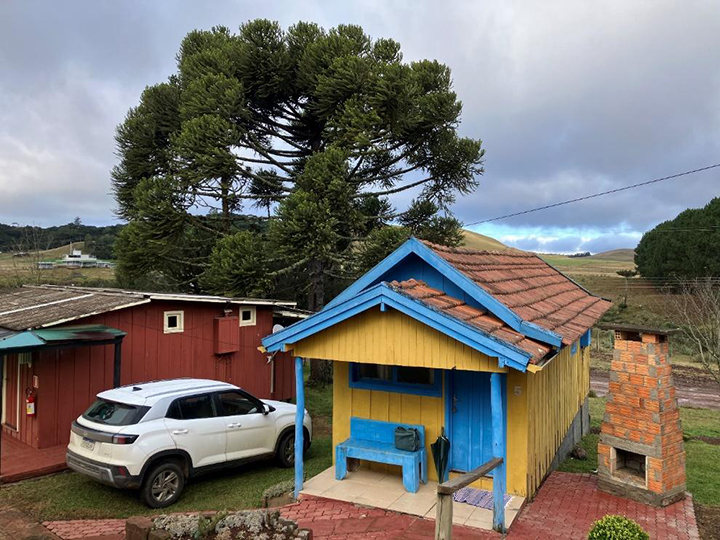
It hasn’t really been so long since Araucaria logging and lumbering was in full swing—up until at least the 1960s, Araucaria were being cut everywhere. Wood can last a long time, and the legacy of that lumbering era can be seen across the region. I stayed in a cabin built from Araucaria boards near Cambará do Sul; it was cold at that elevation in mid-winter, and the wind was howling outside one night and finding plenty of cracks to come in through. I sat at many tables in small local restaurants made from Araucaria slabs. The pattern of knots from the growth whirls of branches is revealed in the sawn wood; it’s beautiful! Araucaria wood is a ubiquitous reminder of the forest that was here and that is now mostly gone.
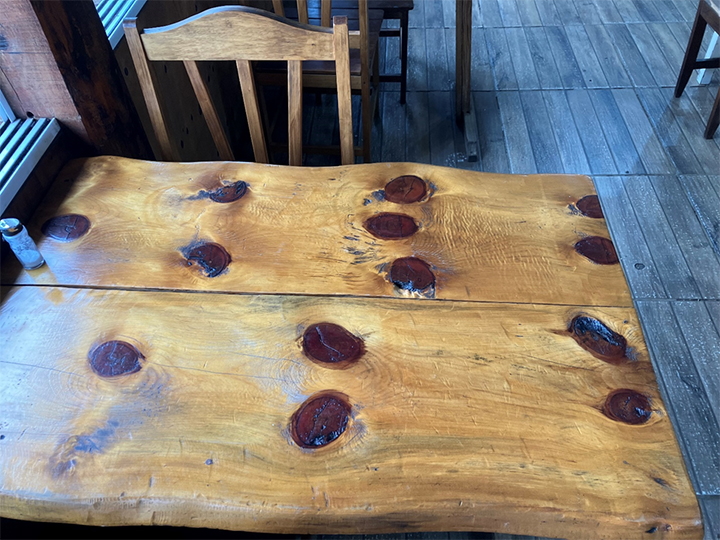
(cores from whirls of branches make lines of dark circles)
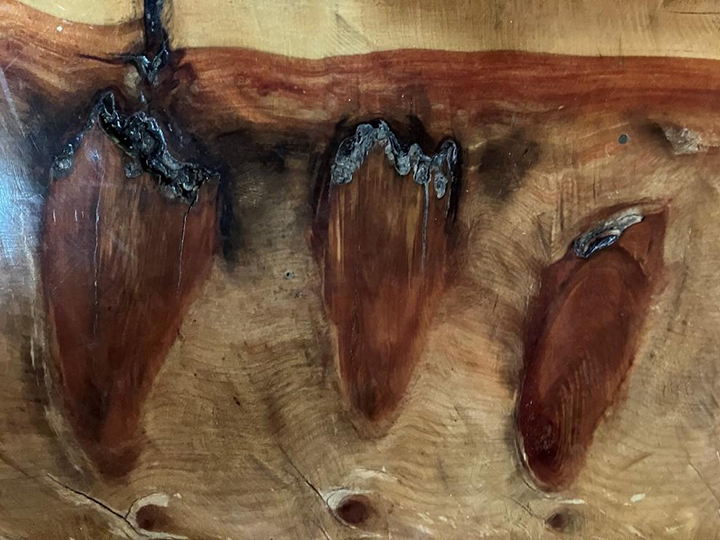
(dark wood are branch cores)
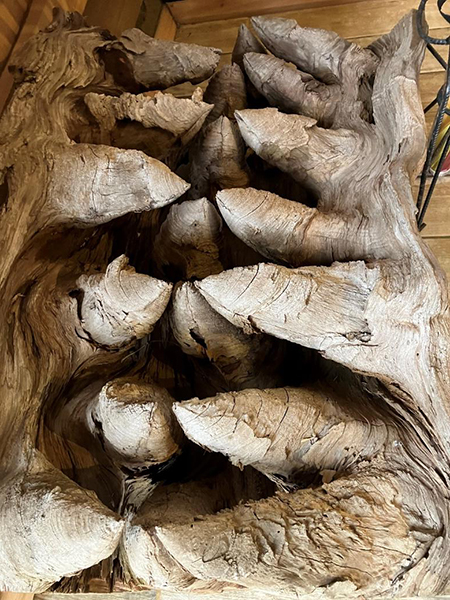
_______
There is another down-to-earth reason that people love these trees: They still harvest and eat Araucaria nuts, called pinhões. In areas where there are still patches of Araucaria forest you can buy them at roadside stands raw or cooked, or even buy the whole cones. I saw them in bins in the produce section of regular, large grocery stores. Gourmet chefs are busy inventing new ways to cook with them, and anyone who grew up in Araucaria country knows at least a few of grandma’s recipes using pinhões.
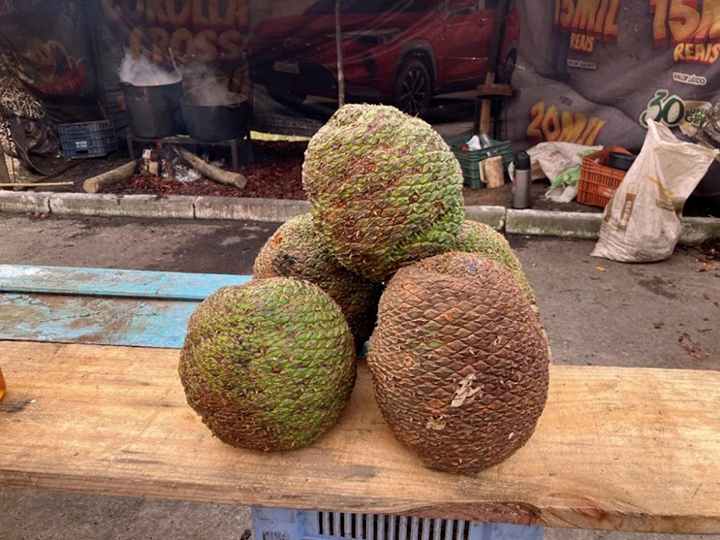
of cannonballs, at a roadside stand on the way to Urubici, June 2026
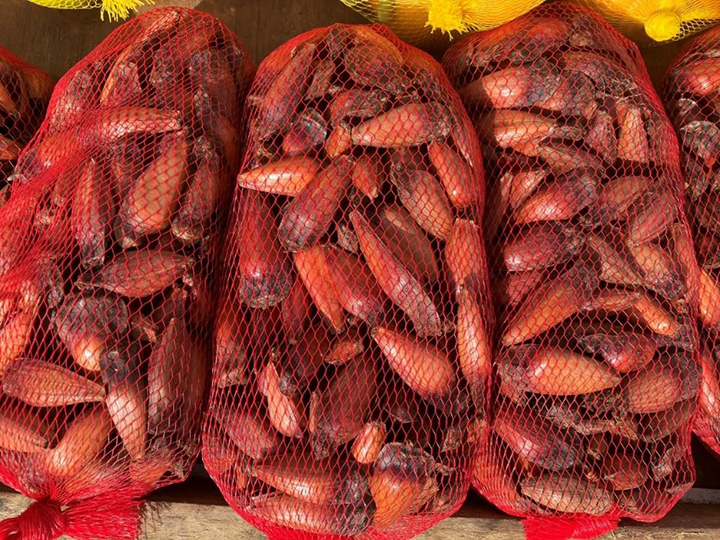
about $4.00 US, at a sidewalk stand in Curitiba, June 2026
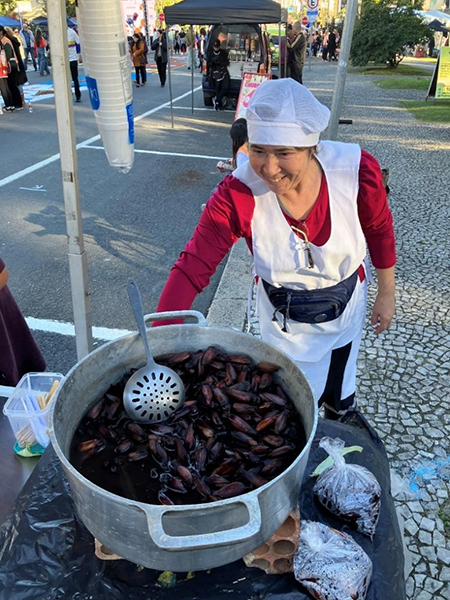
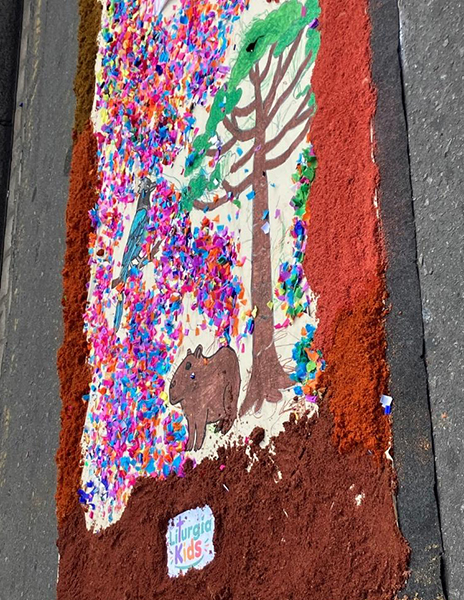
Corpus Christi Day festival, Curitiba, June 4, 2026
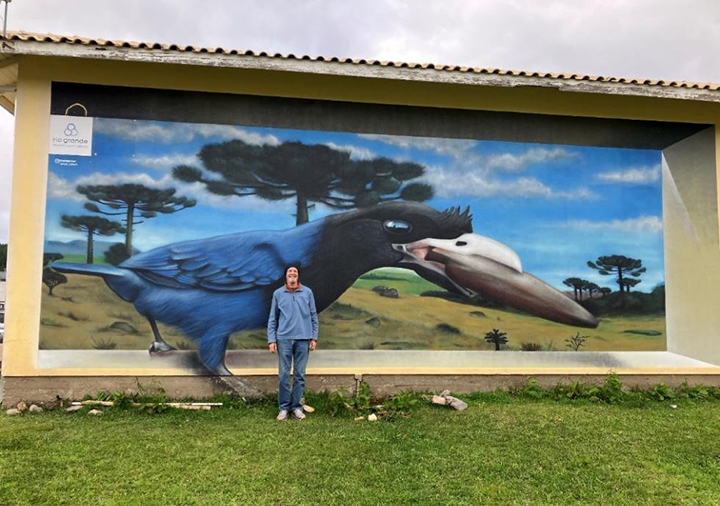
The Grahla-azul or Azure Jay, (Cyanocorax coeruleus), is a key symbiotic species of the Araucaria forest because of its major role in seed dispersal.3 Azure Jays live on Araucaria seeds when they are in season, and like the cutia (Azara’s agouti, Dasyprocta azarae) mentioned in a previous essay, they are scatter hoarders. Seeds from their occasionally forgotten caches of pinhões sometimes germinate and grow. Noisy gangs of Azure jays are ubiquitous in Araucaria country and are familiar to anyone living there. Signs and murals like those pictured above educate residents of Araucarilândia to the ecological role of the Grahla-azul.
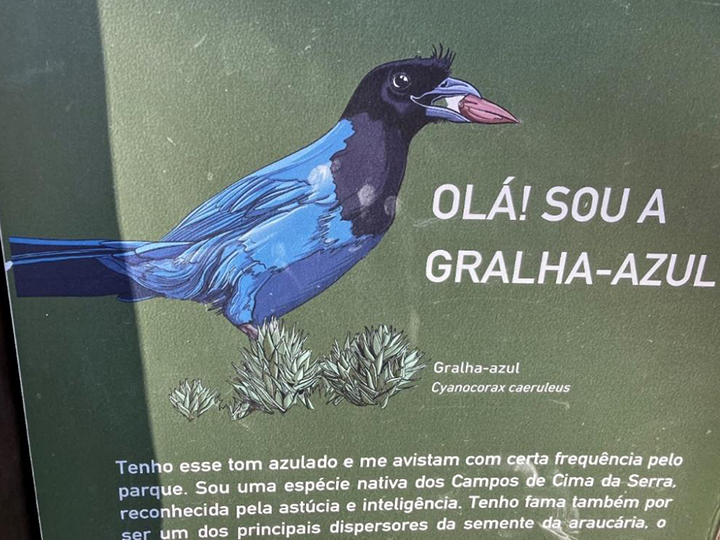
Information sign at Aparados da Serra National Park
A street “carpet” mural (tapete) at the Corpus Cristi Day festival in Curitiba on June 4, made from colored sawdust and torn paper by school children, depicted an Araucaria and its seed dispersers, the Grahla-azul and cutia (below).
_______
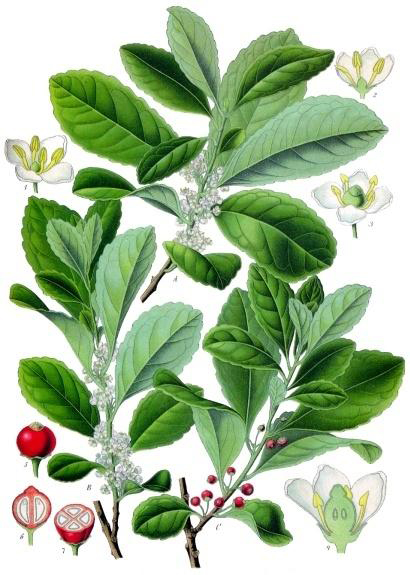
Chimarrão, a particular way of preparing of yerba mate in southern Brazil, is a common cultural habit that links Araucarilânders with their ecoregion. Erva mate (the Brazilian spelling), scientific name Ilex paraguaiensis, is a species of the holly family found as an understory shrub or small tree in Araucaria forests. The leaves of this plant contain the stimulant chemicals caffeine and theobromine, like tea and coffee, and were used by the indigenous peoples of Araucarilândia. The earliest European colonists of the area took up the habit, and yerba mate gathering and trade became a major economic activity. Although it has the same active stimulant compounds, yerba mate interacts with the brain and body differently than coffee for most people, including me—somehow milder and mellower. Yerba mate has a holly-family relative in southeastern North America, yaupon (Ilex vomitoria), which was also used by Indigenous people and European colonists to make yaupon tea.4
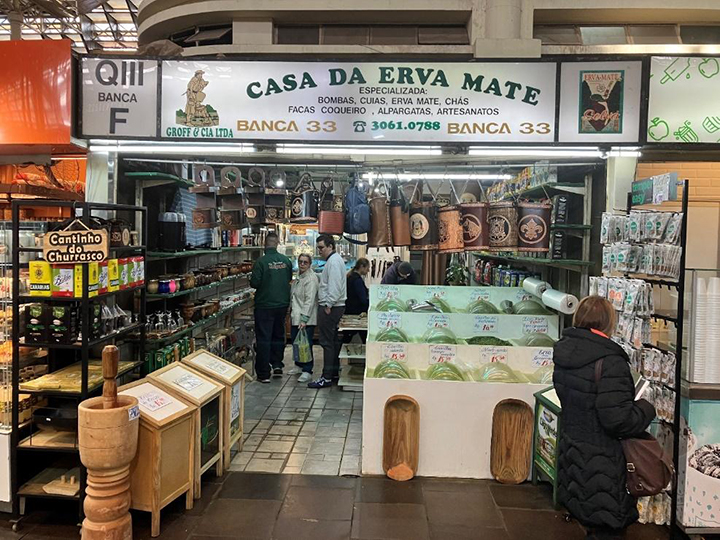
sells many types of erva mate and the paraphernalia needed for chimarrão
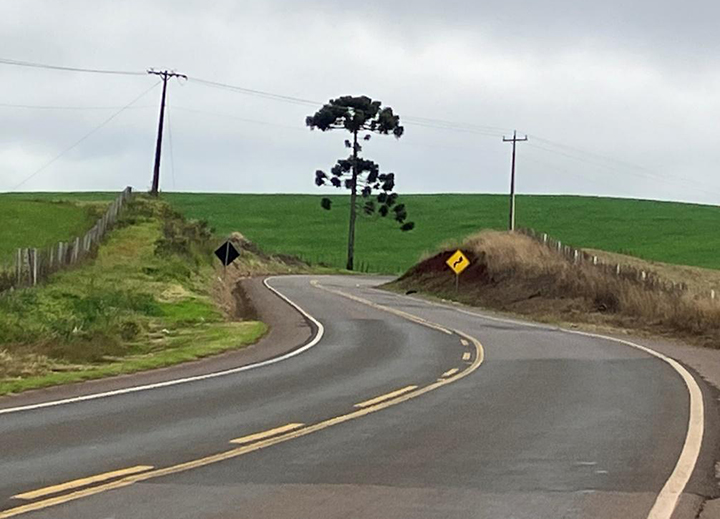
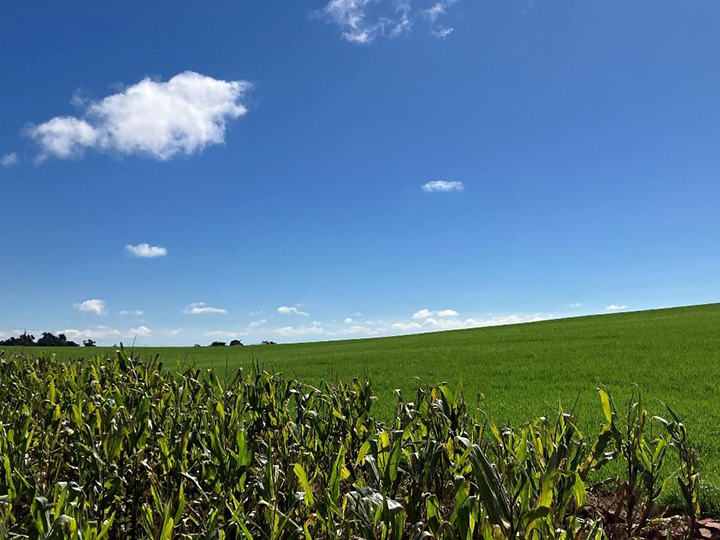
The last part of my month-long trip involved driving north from Santa Maria in Rio Grande do Sul state, up onto and across the volcanic highlands of Santa Catarina and Paraná states to Iguaçu Falls, and then back to Curitiba. This was once the heart of the vast Araucaria forests and grasslands of Araucarilândia. Now it’s farm county. Maize and soybeans to the horizon in some places, like in Iowa or Indiana. Brazil is the third-largest producer of maize in the world, after the U.S. and China; it produces about 11 percent of the global total. It is the world’s largest soybean producer, with 42 percent of global production, 50 percent more than the U.S. at number two. Those crops mostly go to feed animals, and Brazil beats the U.S. in production of beef, at about 20 percent of the world’s total. Bye-bye big trees, hello hamburgers.
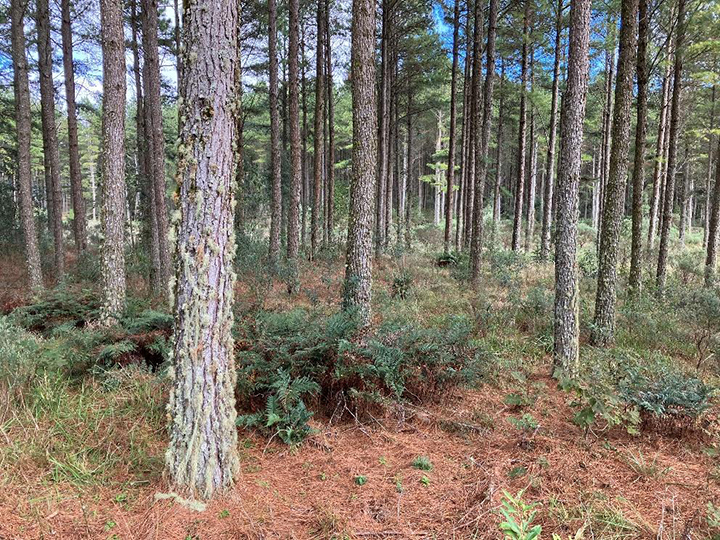
Or if not crop fields, much of the landscape was now tree “farms,” plantations of exotic pines from the southeastern United States (Pinus taeda, Loblolly Pine, or P. elliotii, Slash Pine) or Eucalyptus from Australia.
The forest may be gone, but lone and lonely Araucarias stand out everywhere: along the highways, in cornfields, beside gas stations, in little towns. Reminders. The ghosts of the old ecosystem.
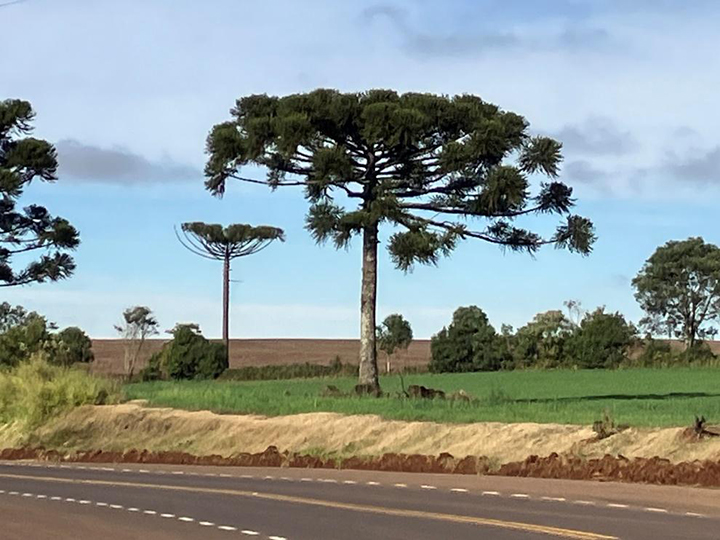
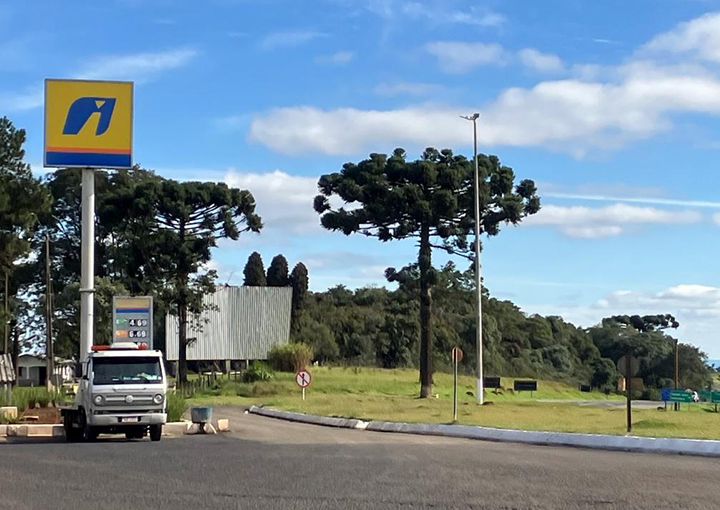
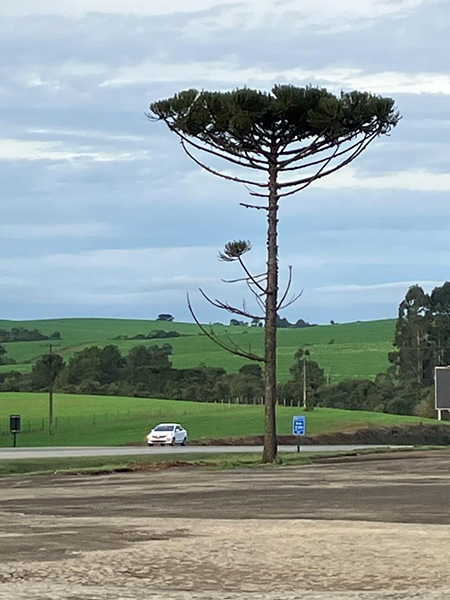
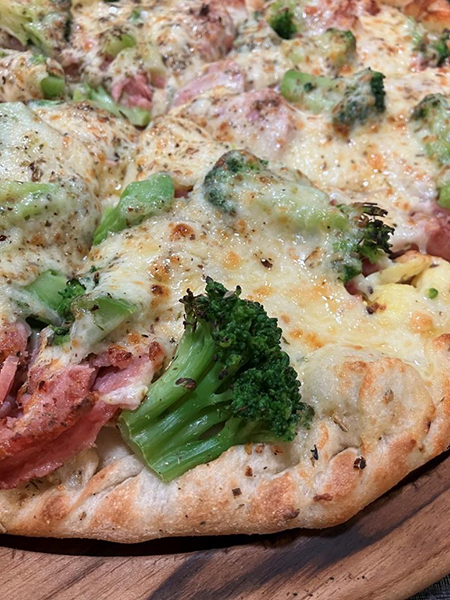
Yes, reminders of the ghost forest of Araucarilândia are everywhere. Even at a pizzeria in Curitiba near my hotel there, DNA da Pizza.
For related stories see
- Following John Muir to Brazil in Search of the Paraná Pine (August 3, 2026)
- The Araucaria War (August 21, 2026)
- A Visit to the Big Tree (September 11, 2026)
Notes & Sources
- A YouTube video recording of my talk “In Search of Araucaria: John Muir’s Journey to Brazil and Chile in 1911” at the University of Santa Catarina in Florianópolis, June 9, 2026 can be found here: https://www.youtube.com/live/QWzp1vcvNos
- Araucarilândia, p. 89. https://www.araucarilandia.com.br/wp-content/uploads/2021/01/Araucarilandia-Livro-e-Caderno-Suplementar-Web.pdf
- A North American relative of the Azure Jay, the Island Scrub-jay (Aphelocoma insularis), plays a similar symbiotic seed-dispersal role for the Island Live Oak (Querqus chrysolepis) on Santa Cruz Island in the California Channel Islands. I described that relationship in my book Nature on the Edge: Lessons for the Biosphere from the California Coast (Oregon State University Press, 2024).
- Yaupon, Ilex vomitoria https://en.wikipedia.org/wiki/Ilex_vomitoria
- Yerba Mate (Ilex paraguaiensis), Source of illustration: Wikipedia https://en.wikipedia.org/wiki/Yerba_mate#/media/File:Ilex_paraguariensis_-_K%C3%B6hler%E2%80%93s_Medizinal-Pflanzen-074.jpg


